Today's
EarthStation1.com 15% Off Commemorative Memorial Title: American
Revolutionary War Documentaries DVD, Download, USB Drive
Today, October 11, 2025
October 11: General Pulaski Memorial Day:
-- October 11, 1779: #DOTD: #RIP: Casimir Pulaski, Polish
nobleman, American Revolutionary War general and Freemason, known
along with his counterpart Michael Kovats de Fabriczy as "The
Founding Fathers Of The US Cavalry" (b. March 4 or March 6,
1747) #dies of grapeshot wounds while leading a cavalry charge in
an attempt to rally fleeing French forces. General Pulaski
Memorial Day on October 11th honors this Polish hero of the
American Revolution, as well as Polish immigrants and their
descendants across the country, who have contributed to the
founding of the United States, and the continued growth and
welfare of the nation. The grapeshot responsible for taking
Casimir Pulaski's life is on display at the Georgia Historical
Society in Savannah. The Charleston Museum also has a grapeshot
reported to be from Pulaski's wound. Despite his fame, there have
long been uncertainties and controversies surrounding both his
death and burial, as well as both the place and date of his birth.
The generally accepted account of his death is that Pulaski was
carried from the field of battle and taken aboard the South
Carolina merchant brig privateer Wasp, under the command of
Captain Samuel Bulfinch, where he died two days later, having
never regained consciousness. Many primary sources record a burial
at sea; however, the historical accounts for Pulaski's time and
place of burial vary considerably. According to several
contemporary accounts there were witnesses, including Pulaski's
aide-de-camp, that Pulaski received a symbolic burial in
Charleston on October 21, sometime after he was buried at sea.
Other witnesses, including Captain Samuel Bulfinch of the Wasp,
however, claimed that the wounded Pulaski was actually later
removed from the ship and taken to the Greenwich Plantation in the
town of Thunderbolt, near Savannah, where he died and was buried.
Despite these discrepancies, his undisputed heroic death, admired
by American Patriot supporters, further boosted his reputation in
America. Some forty-six years later, in March 1825, during his
grand tour of the United States, his Comrade-In-Arms General
Gilbert du Motier, Marquis de Lafayette personally laid the
cornerstone for the Casimir Pulaski Monument in Monterey Square in
Savannah, Georgia during a full Masonic ceremony with Richard T.
Turner, High Priest of the Georgia chapter, conducting the
service; Pulaski was a member of the Masonic Army Lodge in
Maryland (a Masonic Lodge in Chicago is named Casimir Pulaski
Lodge, No.1167, and a brochure issued by the lodge claims he
obtained the degree of Master Mason on June 19, 1779, and was
buried with full Masonic honours.). Casimir Pulaski was born
Kazimierz Michal Wladyslaw Wiktor Pulaski in Warsaw,
Polish-Lithuanian Commonwealth (modern Poland), Casimir Pulaski is
remembered as a hero who fought for independence and freedom in
both Poland and the United States. Numerous places and events are
named in his honor, and he is commemorated by many works of art.
Pulaski is one of only eight people to be awarded honorary United
States citizenship. Before aiding in the American Revolution, he
was a military leader in Poland's struggle against Russia. He
joined the Americans in 1777 and fought alongside General
Washington at Brandywine, then served at Germantown and Valley
Forge. He was mortally wounded during a heroic charge in the Siege
of Savannah, Georgia. Kazimierz Michal Wladyslaw Wiktor Pulaski of
Slepowron followed in his father's footsteps, becoming interested
in politics at an early age and soon becoming involved in the
military and the revolutionary affairs in the Polish-Lithuanian
Commonwealth. Pulaski was one of the leading military commanders
for the Bar Confederation and fought against Russian domination of
the Commonwealth. When this uprising failed, he was driven into
exile. Following a recommendation by Benjamin Franklin, Pulaski
travelled to North America to help in the cause of the American
Revolutionary War. He distinguished himself throughout the
revolution, most notably when he saved the life of George
Washington. Pulaski became a general in the Continental Army,
created the Pulaski Cavalry Legion and reformed the American
cavalry as a whole. At the Battle of Savannah, while leading a
cavalry charge against British forces, he was fatally wounded by
grapeshot, and died shortly thereafter. On Sale @ 15% Off Discount
Till Midnight PT!
https://store.earthstation1.com/american-revolutionary-war-dvd-documentaries.html
Today's
EarthStation1.com 15% Off Commemorative Memorial Title: The
Eleanor Roosevelt Story 1965 Biographical Film DVD, Download, USB
Today, October 11, 2025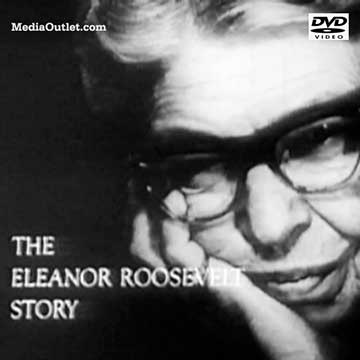
October 11, 1884: #BOTD: #HBD! Eleanor
Roosevelt, American political figure, diplomat, activist,
humanitarian and politician, 39th First Lady of the United States,
considered the most highly esteemed woman of the twentieth century
(d. November 7, 1962) is #born Anna Eleanor Roosevelt in
Manhattan, in New York City. She served as the First Lady of the
United States from March 4, 1933, to April 12, 1945, during her
husband President Franklin D. Roosevelt's four terms in office,
making her the longest-serving First Lady of the United States.
Roosevelt served as United States Delegate to the United Nations
General Assembly from 1945 to 1952. President Harry S. Truman
later called her the "First Lady of the World" in
tribute to her human rights achievements. Roosevelt was a member
of the prominent American Roosevelt and Livingston families and a
niece of President Theodore Roosevelt. She had an unhappy
childhood, having suffered the deaths of both parents and one of
her brothers at a young age. At 15, she attended Allenwood Academy
in London and was deeply influenced by its headmistress Marie
Souvestre. Returning to the U.S., she married her fifth cousin
once removed, Franklin Delano Roosevelt, in 1905. The Roosevelts'
marriage was complicated from the beginning by Franklin's
controlling mother, Sara, and after Eleanor discovered her
husband's affair with Lucy Mercer in 1918, she resolved to seek
fulfillment in leading a public life of her own. She persuaded
Franklin to stay in politics after he was stricken with a
paralytic illness in 1921, which cost him the normal use of his
legs, and began giving speeches and appearing at campaign events
in his place. Following Franklin's election as Governor of New
York in 1928, and throughout the remainder of Franklin's public
career in government, Roosevelt regularly made public appearances
on his behalf, and as First Lady, while her husband served as
president, she significantly reshaped and redefined the role of
First Lady. Though widely respected in her later years, Roosevelt
was a controversial First Lady at the time for her outspokenness,
particularly on civil rights for African Americans. She was the
first presidential spouse to hold regular press conferences, write
a daily newspaper column, write a monthly magazine column, host a
weekly radio show, and speak at a national party convention. On a
few occasions, she publicly disagreed with her husband's policies.
She launched an experimental community at Arthurdale, West
Virginia, for the families of unemployed miners, later widely
regarded as a failure. She advocated for expanded roles for women
in the workplace, the civil rights of African Americans and Asian
Americans, and the rights of World War II refugees. Following her
husband's death in 1945, Roosevelt remained active in politics for
the remaining 17 years of her life. She pressed the United States
to join and support the United Nations and became its first
delegate. She served as the first chair of the UN Commission on
Human Rights and oversaw the drafting of the Universal Declaration
of Human Rights. Later, she chaired the John F. Kennedy
administration's Presidential Commission on the Status of Women.
Eleanor Roosevelt died of cardiac failure brought on by a dormant
case of tuberculosis in her bone marrow at the age of 78 at her
Manhattan home at 55 East 74th Street on the Upper East Side. In
April 1960, Roosevelt was diagnosed with aplastic anemia soon
after being struck by a car in New York City, and when she was
given steroids to treat it 1962, it activated her dormant
tuberculosis. She is buried at The Franklin D. Roosevelt National
Historic Site in Hyde Park, Dutchess County, New York. By the time
of her death, Roosevelt was regarded as "one of the most
esteemed women in the world"; The New York Times called her
"the object of almost universal respect" in an obituary.
In 1999, she was ranked ninth in the top ten of Gallup's List of
Most Widely Admired People of the 20th Century. On Sale @ 15% Off
Discount Till Midnight PT!
https://store.earthstation1.com/the-eleanor-roosevelt-story-dvd-1965-macleish-seva1965.html
Today's
EarthStation1.com #OnThisDay Commemorative Memorial Title:
America: The Second Century Documentary Series DVD, Download, USB
Today, October 11, 2025 October 11: Miners' Day (Mother Jones'
Day): -- October 11, 1936: An estimated 50,000 people arrived at
Mother Jones's grave to see the new gravestone and memorial
dedicated to her. Since then, October 11 is not only known as
Miners' Day but is also referred to and celebrated in Mount Olive
as "Mother Jones' Day." Mother Jones, Irish-born
American organizer, former schoolteacher and dressmaker, called
"the most dangerous woman in America" in 1902 for her
success in organizing mine workers and their families against the
mine owners, prominent union organizer, community organizer, and
activist (b. May 1, 1830 [Self-Proclaimed] #died at the farm of
her friends Walter and Lillie May Burgess in what was then Silver
Spring, Maryland, now part of Adelphi. There was a funeral Mass at
St. Gabriel's in Washington, D.C. She is buried in the Union
Miners Cemetery in Mount Olive, Illinois, alongside miners who
died in the 1898 Battle of Virden. She called these miners, killed
in strike-related violence, "her boys." In 1932, about
15,000 Illinois mine workers gathered in Mount Olive to protest
against the United Mine Workers, which soon became the Progressive
Mine Workers of America. Convinced that they had acted in the
spirit of Mother Jones, the miners decided to place a proper
headstone on her grave. By 1936, the miners had saved up more than
16K USD and were able to purchase "eighty tons of Minnesota
pink granite, with bronze statues of two miners flanking a
twenty-foot shaft featuring a bas-relief of Mother Jones at its
center." The farm where she died began to advertise itself as
the "Mother Jones Rest Home" in 1932, before being sold
to a Baptist church in 1956. The site is now marked with a
Maryland Historical Trust marker, and a nearby elementary school
is named in her honor. Mother Jones was born Mary G. Harris on the
north side of Cork, Ireland. Her exact date of birth is uncertain;
she was baptized on August 1, 1837, so it is presumed she was
actually born on 1837, not in her self-proclaimed birth year. She
amd her family were victims of the Great Famine, which drove more
than a million families, including her family the Harrises, to
immigrate to North America when Harris was 10. Mother Jones helped
coordinate major strikes, secure bans on child labor, and
co-founded the socialist trade union, the Industrial Workers of
the World (IWW). After Jones's husband and four children all died
of yellow fever in 1867 and her dress shop and all of her
belongings were destroyed in the Great Chicago Fire of 1871, she
then devoted herself to organizing and advancing the cause of
Labor, using the slogan, "Join the Union, boys." She
became an organizer for the Knights Of Labor and the United Mine
Workers union. She also sought to prohibit child labor; in 1903,
to protest the lax enforcement of the child labor laws in the
Pennsylvania mines and silk mills, she organized a children's
march from Philadelphia to the home of President Theodore
Roosevelt in New York. She remained active until the very end,
giving her last speech on her self-problaimed 100th birthday.
https://store.earthstation1.com/america-the-second-century-us-2nd-100-years-history-621006.html
October 11: Miners' Day (Mother Jones'
Day): -- October 11, 1936: An estimated 50,000 people arrived at
Mother Jones's grave to see the new gravestone and memorial
dedicated to her. Since then, October 11 is not only known as
Miners' Day but is also referred to and celebrated in Mount Olive
as "Mother Jones' Day." Mother Jones, Irish-born
American organizer, former schoolteacher and dressmaker, called
"the most dangerous woman in America" in 1902 for her
success in organizing mine workers and their families against the
mine owners, prominent union organizer, community organizer, and
activist (b. May 1, 1830 [Self-Proclaimed] #died at the farm of
her friends Walter and Lillie May Burgess in what was then Silver
Spring, Maryland, now part of Adelphi. There was a funeral Mass at
St. Gabriel's in Washington, D.C. She is buried in the Union
Miners Cemetery in Mount Olive, Illinois, alongside miners who
died in the 1898 Battle of Virden. She called these miners, killed
in strike-related violence, "her boys." In 1932, about
15,000 Illinois mine workers gathered in Mount Olive to protest
against the United Mine Workers, which soon became the Progressive
Mine Workers of America. Convinced that they had acted in the
spirit of Mother Jones, the miners decided to place a proper
headstone on her grave. By 1936, the miners had saved up more than
16K USD and were able to purchase "eighty tons of Minnesota
pink granite, with bronze statues of two miners flanking a
twenty-foot shaft featuring a bas-relief of Mother Jones at its
center." The farm where she died began to advertise itself as
the "Mother Jones Rest Home" in 1932, before being sold
to a Baptist church in 1956. The site is now marked with a
Maryland Historical Trust marker, and a nearby elementary school
is named in her honor. Mother Jones was born Mary G. Harris on the
north side of Cork, Ireland. Her exact date of birth is uncertain;
she was baptized on August 1, 1837, so it is presumed she was
actually born on 1837, not in her self-proclaimed birth year. She
amd her family were victims of the Great Famine, which drove more
than a million families, including her family the Harrises, to
immigrate to North America when Harris was 10. Mother Jones helped
coordinate major strikes, secure bans on child labor, and
co-founded the socialist trade union, the Industrial Workers of
the World (IWW). After Jones's husband and four children all died
of yellow fever in 1867 and her dress shop and all of her
belongings were destroyed in the Great Chicago Fire of 1871, she
then devoted herself to organizing and advancing the cause of
Labor, using the slogan, "Join the Union, boys." She
became an organizer for the Knights Of Labor and the United Mine
Workers union. She also sought to prohibit child labor; in 1903,
to protest the lax enforcement of the child labor laws in the
Pennsylvania mines and silk mills, she organized a children's
march from Philadelphia to the home of President Theodore
Roosevelt in New York. She remained active until the very end,
giving her last speech on her self-problaimed 100th birthday.
https://store.earthstation1.com/america-the-second-century-us-2nd-100-years-history-621006.html
Today's
EarthStation1.com 15% Off Commemorative Memorial Title: The
Beginning or the End (1947) Manhattan Project DVD, Download, USB
Today, October 11, 2025
October 11, 1939: The European Civil War:
World War II: The Second European War (The European Theater Of
World War II): Nuclear Weapons Programs Of The United States: The
Manhattan Project (Codename: Development Of Substitute Materials):
The Einstein-Szilard Letter: -- Alexander Sachs, Wall Street
economist, banker and longtime friend and unofficial advisor to
President Franklin Delano Roosevelt, met with the President to
discuss the Einstein-Szilard letter sent on August 2, a letter
written by Leo Szilard in consultation with fellow Hungarian
physicists Edward Teller and Eugene Wigner and signed by Albert
Einstein which warned President Roosevelt that nuclear-fission
research and Einstein's theories could lead to Nazi Germany's
development of an atomic bomb, and suggested that the United
States should start its own nuclear program. It prompted action by
Roosevelt, which eventually resulted in the top secret Manhattan
Project, the American research and development undertaking during
World War II that produced the first nuclear weapons. On Sale @
15% Off Discount Till Midnight PT!
https://store.earthstation1.com/the-beginning-or-the-end-dvd-1947-atomic-bomb-manhattan-pro1947.html
Today's
EarthStation1.com 15% Off Commemorative Memorial Title: WWII
Films: Japanese Internment & Films About Japan DVD, Download,
USB
Today, October 11, 2025
(#J.C. Kaelin here: Although the
particular rationale that I am about to describe for the
internment of Japanese Americans was never specifically
articulated, I have personally concluded that it was actually
intended to obtain hostages of Japanese ancestry to use to induce
Imperial Japan not to mistreat the some 1.5 million prisoners and
internees of European ancestry that they had thusfar obtained
since the war began on December 7, with the intention of
preventing the further torture, inhumane treatment and abuse that
they were reportedly being subjected to during their captivity by
the Japanese. - J. C. Kaelin, December 18, 2023.) =========
October 11, 1944: World War II: The United States Home Front
During World War II: The Pacific War (The Asia-Pacific War, The
Asiatic-Pacific Theater, The Pacific Theater Of World War II): The
History Of Asian Americans: The History of Japanese Americans: The
Internment Of Japanese Americans: Korematsu v. United States: --
The Supreme Court Of The United States (SCOTUS) begins to hear
arguments in the Korematsu v. United States case, in which the
plaintiff Fred Korematsu challenged Franklin D. Roosevelt's
Executive Order 9066 (EO9066) that cleared the way for the
incarceration of himself, and nearly all 120,000 Japanese
Americans, two-thirds of whom were U.S. citizens, born and raised
in the United States that were located in the West Coast Military
Area (The West Coast Of The United States, also known as The
Pacific Coast, The Pacific Seaboard, and the Western Seaboard,
which included the contiguous U.S. states of California, Oregon,
and Washington, as well as the American territories [now states]
of Alaska and Hawaii) during World War II. On December 18: 1944,
SCOTUS issued its landmark ruling on the case, which entirely
supported EO9066; the decision has since been widely criticized,
with some scholars describing it as "an odious and
discredited artifact of popular bigotry", and as "a
stain on American jurisprudence". The case is often cited as
one of the worst Supreme Court decisions of all time. Chief
Justice John Roberts repudiated the Korematsu decision in his
majority opinion in the 2018 case of Trump v. Hawaii. In the
aftermath of Imperial Japan's attack on Pearl Harbor, President
Franklin D. Roosevelt had issued Executive Order 9066 on February
19, 1942, authorizing the U.S. War Department to create military
areas from which any or all Americans might be excluded.
Subsequently, the Western Defense Command, a U.S. Army military
command charged with coordinating the defense of the West Coast of
the United States, ordered "all persons of Japanese ancestry,
including aliens and non-aliens" to relocate to internment
camps. However, a 23-year-old Japanese-American man, Fred
Korematsu, refused to leave the exclusion zone and instead
challenged the order on the grounds that it violated the Fifth
Amendment. In a majority opinion joined by five other justices,
Associate Justice Hugo Black held that the need to protect against
espionage by Japan outweighed the rights of Americans of Japanese
ancestry. Black wrote that "Korematsu was not excluded from
the Military Area because of hostility to him or his race",
but rather "because the properly constituted military
authorities...decided that the military urgency of the situation
demanded that all citizens of Japanese ancestry be segregated from
the West Coast" during the war against Japan. Dissenting
justices Frank Murphy, Robert H. Jackson, and Owen J. Roberts all
criticized the exclusion as racially discriminatory; Murphy wrote
that the exclusion of Japanese "falls into the ugly abyss of
racism" and resembled "the abhorrent and despicable
treatment of minority groups by the dictatorial tyrannies which
this nation is now pledged to destroy." The Korematsu opinion
was the first instance in which the Supreme Court applied the
strict scrutiny standard of review to racial discrimination by the
government; it is one of only a handful of cases in which the
Court held that the government met this standard. Korematsu's
conviction was voided by a California district court in 1983 on
the grounds that Solicitor General Charles H. Fahy had suppressed
a report from the Office of Naval Intelligence which stated there
was no evidence that Japanese Americans were acting as spies for
Japan. The Japanese-Americans who were interned were later granted
reparations through the Civil Liberties Act of 1988. On Sale @ 15%
Off Discount Till Midnight PT!
https://store.earthstation1.com/wwii-films-japanese-internment-and-us-films-about-japan-dvd.html
Today's
EarthStation1.com 15% Off Commemorative Memorial Title: The Open
Mind With Bill Jenkins Radio Series DVD, MP3 Download, USB
Today, October 11, 2025
October 11, 1944: #BOTD: #HBD! Patrick
Flanagan, American author and inventor. known as "The Father
Of The New Age Movement", inventor of the Neurophone,
MegaHydrate and Crystal Energy (d. December 19, 2019) is #born
Gillis Patrick Flanagan in Oklahoma City, Oklahoma to Betty
McKitty and Gillis Charles Flanagan. Revered for his life and
inventions, Patrick Flanagan was treasured for his generosity and
kindness and was an international icon in the New Age community.
Author of the 1973 blockbuster book Pyramid Power, Dr. Flanagan is
considered a 'Father of the New Age' movement through his health
and wellness inventions. His early work with Henri Coanda led him
to breakthroughs in hydration that helped countless people. Aged
75, he died December 19,, 2019 in his home in Loja province
Ecuador after battling complications of a fall and severe
infection. Dr. Flanagan gained international scientific fame from
a very young age. At age eleven, he developed and sold a guided
missile detector to the U.S. Military after being discovered at
his school's science fair. At age thirteen he invented the brain
balancing Neurophone. By seventeen he was featured in a LIFE
Magazine article as one of America's most promising young
scientists after which he was invited to be part of an elite
government think tank. Following the promise of his youth Dr.
Flanagan would go on to invent over 300 devices and supplements,
specializing in boosting health and wellness. Patrick Flanagan
died in his home aged 75 in Loja province Ecuador after battling
complications of a fall and severe infection. His burial details
are not publicly disclosed. Dr. Flanagan is survived by his love
and partner Stephanie Sutton. She is dedicated to continuing his
life's work through the company he formed in Cottonwood,
Arizona-called PhiSciences. He is survived by his brother Michael
Flanagan and his wife MaryLee and son Chaz, his son John Patrick
(Wing) Flanagan and his wife Anshu and daughter Sharma Adams and
her husband Albert Adams. Also survived are Patrick's three
grandchildren, Jaitong, Noah Watts and TJ Adams and his
step-daughter Gwendolyn Dearborn. Deepak Chopra said of Dr.
Patrick Flanagan: "Patrick Flanagan was a spiritual and
scientific genius and extraordinary human being with unlimited
compassion and love in his heart. I'm grateful to have known him
in this thin slice of cosmic time. He helped my own personal
spiritual journey with his insight and friendship I wish him happy
trails on his continued journey." (Our thanks to the
AZCentral website for this appropriately reverent and historically
accurate biography.) On Sale @ 15% Off Discount Till Midnight PT!
https://store.earthstation1.com/the-open-mind-with-bill-jenkins-radio-mp3-dvd-alternate-scienc3.html
Today's
EarthStation1.com 15% Off Commemorative Memorial Title: The
Satellite Sky: The Space Race DVD, Video Download, USB Flash Drive
Today, October 11, 2025
October 11, 1958: Rocket Launches: The
Space Age: The Space Race: Science: The History Of Science: Earth
Science: The History Of Earth Science: Geophysics: The Cold War:
The Cold War (1953-1962): The International Polar Years (IPY): The
Third International Polar Year: The International Geophysical Year
(IGY) (French: Annee Geophysique Internationale): Space Probes:
Lunar Space Probes: The Pioneer Program: Pioneer 1 -- NASA
launches its first space probe when the Pioneer 1 is sent into
space atop a Thor DM-18 Able I launch vehicle at 08:42:00 GMT from
the Cape Canaveral Space Launch Complex 17 (LC-17). Its mission
was to study the moon and consisted of an image scanning infrared
television system to study the Moon's surface to a resolution of
0.5 degrees, an ionization chamber to measure radiation in space,
a diaphragm/microphone assembly to detect micrometeorites, a
spin-coil magnetometer to measure magnetic fields to 5 microgauss,
and temperature-variable resistors to record the spacecraft's
internal conditions. It did not reach the Moon as planned due to a
programming error in the upper stage causing a slight error in
burnout velocity and angle (3.5 deg.). The spacecraft ended
transmission when it reentered the Earth's atmosphere after 43
hours of flight on October 13, 1958 at 03:46 UT over the South
Pacific Ocean. A small quantity of useful scientific information
was returned, showing the radiation surrounding Earth was in the
form of bands and measuring the extent of the bands, mapping the
total ionizing flux, making the first observations of
hydromagnetic oscillations of the magnetic field, and taking the
first measurements of the density of micrometeorites and the
Interplanetary Magnetic Field. On Sale @ 15% Off Discount Till
Midnight PT!
https://store.earthstation1.com/the-satellite-sky-dvd-cold-war-space-race-films.html
Today's
EarthStation1.com 15% Off Commemorative Memorial Title: Heart Of
The Dragon TV Series DVD, Video Download, USB Flash Drive
Today, October 11, 2025
October 11, 1976: China: The History Of
China: The People's Republic Of China (PRC): The History Of The
People's Republic Of China (The History Of The PRC): Maoism (Mao
Zedong Thought): The Cultural Revolution (The Great Proletarian
Cultural Revolution): The Gang Of Four: -- Mao Zedong's last wife
Jiang Qing, Zhang Chunqiao, Yao Wenyuan, and Wang Hongwen are
arrested in China and charged with plotting a coup, bringing to an
end Cultural Revolution in the People's Republic Of China. They
were subsequently tried and convicted of various crimes against
the state. The Cultural Revolution, formally the Great Proletarian
Cultural Revolution, was a sociopolitical movement that took place
in China from 1966 until 1976 that wet into motion by Mao Zedong,
then Chairman of the Communist Party of China. Its stated goal was
to preserve 'true' Communist ideology in the country by purging
remnants of capitalist and traditional elements from Chinese
society, and to re-impose Maoist thought as the dominant ideology
within the Party. The Revolution marked the return of Mao Zedong
to a position of power after the failure of his Great Leap
Forward. The movement paralyzed China politically and negatively
affected the country's economy and society to a profound degree.
On Sale @ 15% Off Discount Till Midnight PT!
https://store.earthstation1.com/heart-of-the-dragon-dvds-post-mao-china-all-12-tv-shows-3-di123.html
Today's
EarthStation1.com 15% Off Commemorative Memorial Title: Terror:
The Israeli-Palestinian Conflict DVD MP4 Video Download
Today, October 11, 2025
October 11, 1985: The Arab-Israeli
Conflict: The Israeli-Palestinian Conflict: Terrorist Attacks
Attributed To Palestinian Militant Groups: The Palestinian
Liberation Front (PLF): The Achille Lauro Hijacking: The Sigonella
Crisis (The Crisis Of Sigonella): -- A diplomatic incident between
Italy and the United States known as The Sigonella Crisis breaks
out that risked escalating into an armed confrontation between
Italy's VAM (Vigilanza Aeronautica Militare) and Carabinieri rural
police (gendarmerie) on the one hand, and soldiers of America's
Delta Force special forces unit on the other, as a political
rupture between Italian Prime Minister Bettino Craxi and U.S.
President Ronald Reagan about the fate of the terrorists who had
hijacked the Achille Lauro and killed a US passenger. The day
prior, October 10, United States Navy F-14 fighter jets
intercepted an Egyptian plane carrying the Palestinian terrorist
hijackers of the Achille Lauro cruise ship, and forced it to land
at a NATO base in Sigonella, Sicily where they were arrested. The
Achille Lauro Hijacking took place on October 7, 1985, when the
Italian ocean liner MS Achille Lauro was hijacked by four men
representing the Palestine Liberation Front (PLF) off the coast of
Egypt, as she was sailing from Alexandria to Ashdod, Israel. A
69-year-old Jewish American man in a wheelchair, Leon Klinghoffer,
was murdered by the hijackers and thrown overboard. Sigonella was
an Italian Air Force base in Sicily, which housed a U.S. Navy
installation (N.A.S.). The American special forces had surrounded
the airplane, but soon found themselves surrounded by Italian Air
Force soldiers and Carabinieri military police. The Italian
organizations insisted that Italy had territorial rights over the
base and jurisdiction over the hijackers. A standoff between the
SEAL team and the Italian military began. The choice of the
Sigonella base to divert the EgyptAir 737 that had the hijackers
of the Achille Lauro aboard caused a dispute between the
governments of the US and Italy and included elements of their
militaries. On the orders of U.S. president Ronald Reagan and
Secretary Of Defense Caspar Weinberger, the Egyptian airliner
carrying the hijackers was intercepted by F-14 Tomcats from the
VF-74 "BeDevilers" and the VF-103 "Sluggers"
of Carrier Air Wing 17, based on the aircraft carrier USS
Saratoga, and directed to land at Naval Air Station Sigonella (an
Italian NATO air base in Sicily under joint Italian-American
military utilization). The choice of Sigonella became problematic
for the Americans as they had no jurisdiction, and the Italians
were not consulted regarding its use for this operation. The
Egyptian flight, having been authorized by its government, was
lawful under international law. The Egyptian government protested
the American interception of its plane, which was not legal under
international law. Egypt's arguments were somewhat diminished by
its own previous justification for its 1978 raid at Locna airport
in Cyprus. Not only had the Americans not received consent from
the Italians to forcibly land a non-hostile plane flying in
compliance with international law at Sigonella, but the American
military action was taken solely for American purposes (not those
of the NATO alliance) and was taken in order to secure criminals -
this was in violation of the purely joint military purposes that
the Italians had agreed to when deciding to share the utilization
of the base. A standoff occurred when 20 Carabinieri and 30 VAM
(Vigilanza Aeronautica Militare) of the Italian Air Force
contested for control of the plane with the 80 armed operatives of
the U.S. Delta Force and SEAL Team Six. These contesting groups
were soon surrounded by 300 additional armed Carabinieri (the
Italian military police) who had also blocked off the runway with
their trucks. The Italian Air Force (VAM) personnel and
Carabinieri had already been lining up facing the US special
forces soon after the American's main contingent had arrived by
C-141s. Other Carabinieri had been sent from Catania and Syracuse
as reinforcement. These events became known as the Sigonella
Crisis. Stiner and Gormly contacted the Pentagon to inform them of
the situation, and this information was passed onto the Reagan
Administration. Members of the president's staff told the Italian
government that the US special-operations team intended to arrest
the hijackers. The Italians dismissed the Americans' claim of the
right to do so, maintaining that the matter fell within their own
jurisdiction due to the ship sailing under an Italian flag. A
phone call took place between President Reagan and the Prime
Minister Craxi. Craxi claimed Italian territorial rights over the
NATO base. Reagan informed Craxi that the US would seek
extradition of the terrorists to face charges in US courts. Stiner
and his men, standing eyeball-to-eyeball with the 360 armed
Italians, relayed to the Pentagon "I am not worried about our
situation. We have the firepower to prevail. But I am concerned
about the immaturity of the Italian troops... A backfire from a
motorbike or a construction cart could precipitate a shooting
incident that could lead to a lot of Italian casualties. And I
don't believe that our beef is with our ally, the Italians, but
rather with the terrorists." The American leadership in
Washington concluded that while Stiner and his men could take the
terrorists it was unlikely they would be able to get them out of
Italy. By 4:00 a.m. CET the next day, orders arrived for Stiner
and his men to stand down. After five hours of negotiations, and
with the knowledge that the Italian troops had orders (confirmed
by President Francesco Cossiga) to use lethal force if necessary
to block the Americans from leaving with prisoners, the U.S.
conceded the Italian claim of jurisdiction over the terrorists.
The Americans received assurances that the hijackers would be
tried for murder and Stiner and three US officials were to remain
at the airport to witness the arrest of the terrorists by Italian
authorities. After the U.S. turned over control of the 737 to
Italy, Egyptian diplomat Hamed returned to the plane with Italian
base commander Colonel Annicchiarico. Hamed told the men of Unit
777 that the Egyptian government had agreed to turn over the
hijackers to the Italians. Both Abbas and Badrakkan refused to
leave the plane claiming diplomatic rights - maintaining that they
had diplomatic immunity as representatives of the PLO and Arafat.
Learning of this the Egyptian government changed its position,
declaring that the two were on board an Egyptian aircraft on a
government mission - thus accruing extraterritorial rights. Egypt
requested Italy let the plane leave with the two men on board as
they had been brought to Italy against their will. When the
Italians refused this demand the Egyptians denied Achille Lauro
permission to leave Port Said. Prime Minister Craxi sent his
personal foreign affairs advisor Antonio Badini to interview Abbas
after boarding the airliner. Abbas' account held he had been sent
by Arafat due to his persuasive argumentation style, that the four
Palestinians had been triggered by panic to stage the hijacking,
and that the decisive role in releasing the passengers was his
alone. Craxi appeared at a press conference late on Friday,
October 11, acknowledging the role the two played in ending the
hijacking, but inviting them to provide "useful testimony"
and turning the matter over to the Italian court system. After
continued talks between Italy and Egypt, the four hijackers were
eventually removed from the 737, arrested by the Italian
Carabinieri at Sigonella, and taken to the air base jail, then
transferred to a local prison. The public magistrate in Syracuse
announced late on the 11th that his inquires were complete and
EgyptAir 2843 could depart for Rome with Badrakkan and Abbas
aboard. Craxi saw this as a stalling tactic that was a courtesy to
the U.S. The Italian foreign ministry contacted the U.S. embassy
and informed them of the flight, saying that the two wanted to
consult with the PLO office in Rome. The Americans viewed this as
a prelude to Abbas being released. The 737 was then cleared by the
Italians to fly to Rome's Ciampino airport with Abbas and
Badrakkan still aboard. U.S. Major General Stiner, in command of
the American Special Operations Forces at Sigonella, upon learning
that the 737 had been cleared by the Italians to proceed to Rome
with members of the PLF still onboard, became concerned that there
was no guarantee that once airborne it would travel to Rome rather
than back to Cairo. He boarded a T-39 Navy executive jet (the
North American Sabreliner) with other American Special Operations
personnel and planned to shadow the 737. When the Egyptian
airliner took off from Sigonella at 10:00 p.m. the T-39 was not
granted clearance from that runway. In response the Americans used
a parallel runway without Italian permission. In response to the
unauthorized act by Stiner and the Americans, the Italian Air
Force sent in two Aeritalia F-104S Starfighter warplanes of the
36_ Stormo (Wing) from Gioia del Colle. These were soon joined by
two more F-104s from Grazzanise airbase. In response to the
Italian action, other warplanes (that have never been publicly
identified but are assumed to have been American F-14 Tomcats)
came up behind the Italian jets. The Italian jets also found their
radar jammed above the Tyrrhenian Sea, assumingely by a U.S.
Northrop Grumman EA-6B Prowler. National Security Council staffer
Michael K. Bohn in the White House Situation Room at the time,
later recalled "Pilots on board the U.S. and Italian jets
exchanged colorful epithets over the radio about their respective
intentions, family heritage, and sexual preferences." Once
the 737 approached Rome, the formation of U.S. Naval fighters,
turned back - only the T-39 with U.S. special operations forces
continued to Ciampino airport. The Italian air-traffic controllers
at Ciampino denied the T-39 permission to land, but the US pilot
claimed there was an "inflight emergency" which gave him
an automatic right to land the jet. This American violation of
operating in Italian airspace and landing in a Roman airport
without overflight or landing permissions was seen by the Italians
as an affront to their laws and safety regulations and negatively
influenced diplomatic relations between the countries for some
time. Diplomatic relations with Egypt also were negatively
impacted as they continued to demand an apology from the U.S. for
forcing the airplane off course. On Sale @ 15% Off Discount Till
Midnight PT!
https://store.earthstation1.com/terror-the-israelipalestinian-conflict-dvd-mp4-video-downloa4.html
Today's
EarthStation1.com #OnThisDay Commemorative Memorial Title: Classic
Movie Trailers & Drive-In Movie Ads DVD, Download, USB Drive
Today, October 11, 2025 October 11: National Sausage Pizza Day:
-- An annual celebration for food lovers across the country to
enjoy a sausage pizza, today and on any other day of the year!
Whether served on a thin or thick crust, sausage pizza goes well
with other toppings, too. Don't hesitate to add mushrooms and a
variety of cheeses. What's even better about sausage pizza are the
different kinds of sausage to choose from. While Italian sausage
may be preferred, try experimenting. Add more garlic or try
additional spice. Try smoky sausages such as chorizo or even a
kielbasa visit with your local butcher for sausage suggestions.
They've probably been smoking up the latest experiment just for
you to try. Sausage comes in many combinations, too. Lighter forms
and different ages offer flavors that complement our toppings. A
little sweet with the savory creates a modern taste experience.
Sauted onions add amazing flavor to sausage pizza. While cooking
up the onions add a few portabella mushrooms to the pan. Once
you've added them to your pizza, sprinkle the top with feta cheese
and fresh basil. You won't regret it. In ancient Greece, the
Greeks covered their bread with oils, herbs, and cheese, which
some attribute to the actual, ancient beginning of the pizza. In
Byzantine Greek, the word was spelled "pita," pita,
meaning pie. The Romans developed a pastry with a sheet of dough
topped with cheese and honey, then flavored with bay leaves. The
modern pizza had its beginning in Italy as the Neapolitan
flatbread. The original pizza used only mozzarella cheese, mainly
the highest quality buffalo mozzarella variant. It was produced in
the surroundings of Naples. The first United States pizza
establishment opened in New York's Little Italy in 1905. To
observe National Sausage Pizza Day, invite friends and family over
for homemade sausage pizza! Or go out for your favorite kind of
sausage pizza and make it a celebration. While you're out and
about, be sure to give a shout out to your favorite establishment.
Do you like thin or thick crust? How do you eat your pizza? Crust
first, point first or do you fold it? We want to know. Everyone
has their own pizza-eating styles!
https://store.earthstation1.com/classic-movie-trailers-and-drivein-movie-ads-dvds-2-disc-se2.html
October 11: National Sausage Pizza Day:
-- An annual celebration for food lovers across the country to
enjoy a sausage pizza, today and on any other day of the year!
Whether served on a thin or thick crust, sausage pizza goes well
with other toppings, too. Don't hesitate to add mushrooms and a
variety of cheeses. What's even better about sausage pizza are the
different kinds of sausage to choose from. While Italian sausage
may be preferred, try experimenting. Add more garlic or try
additional spice. Try smoky sausages such as chorizo or even a
kielbasa visit with your local butcher for sausage suggestions.
They've probably been smoking up the latest experiment just for
you to try. Sausage comes in many combinations, too. Lighter forms
and different ages offer flavors that complement our toppings. A
little sweet with the savory creates a modern taste experience.
Sauted onions add amazing flavor to sausage pizza. While cooking
up the onions add a few portabella mushrooms to the pan. Once
you've added them to your pizza, sprinkle the top with feta cheese
and fresh basil. You won't regret it. In ancient Greece, the
Greeks covered their bread with oils, herbs, and cheese, which
some attribute to the actual, ancient beginning of the pizza. In
Byzantine Greek, the word was spelled "pita," pita,
meaning pie. The Romans developed a pastry with a sheet of dough
topped with cheese and honey, then flavored with bay leaves. The
modern pizza had its beginning in Italy as the Neapolitan
flatbread. The original pizza used only mozzarella cheese, mainly
the highest quality buffalo mozzarella variant. It was produced in
the surroundings of Naples. The first United States pizza
establishment opened in New York's Little Italy in 1905. To
observe National Sausage Pizza Day, invite friends and family over
for homemade sausage pizza! Or go out for your favorite kind of
sausage pizza and make it a celebration. While you're out and
about, be sure to give a shout out to your favorite establishment.
Do you like thin or thick crust? How do you eat your pizza? Crust
first, point first or do you fold it? We want to know. Everyone
has their own pizza-eating styles!
https://store.earthstation1.com/classic-movie-trailers-and-drivein-movie-ads-dvds-2-disc-se2.html
Today's
EarthStation1.com #OnThisDay Commemorative Memorial Title:
Tennessee Williams' South (1973) DVD, Video Download, USB Flash
Drive
Today, October 11, 2025October 11: Southern Food Heritage Day:
-- The Southern Food & Beverage Museum celebrates the
culturally rich and delicious food of the Southern States in
America. The cuisine deserves to be recognized and celebrated
officially because it is a testament to American history and
legacy. Southern food also represents the essence of America - the
coming together of a variety of people from all over the world,
each bringing with themselves their own ingredients and recipes to
create a unique cuisine. Iced tea, pickled shrimps, and fried
chicken are some of the most loved Southern foods throughout
history. Along with the cuisine, the day also celebrates the
racial and ethnic diversity in America. Southern Food Heritage Day
celebrates the best that Southern food and beverages have to
offer. The South's cuisine in America can be found in the
historical regional culinary form of states generally south of the
Mason-Dixon line dividing Pennsylvania and Delaware from Maryland,
along the Ohio River, and extending west to southern Missouri,
Oklahoma, and Texas. The most notable influences on Southern
cuisine are African, English, Scottish, Irish, German, French and
Native American. The food of the American South displays a unique
blend of cultures and culinary traditions. The Native Americans,
Spanish, French, and British have contributed to the development
of Southern food, with recipes and dishes from their own cultures.
Food items such as squash, tomatoes, corn, as well as certain
cooking practices such as deep pit barbecuing, were introduced by
south-eastern Native American tribes such as the Caddo, Choctaw,
and Seminole. Many foods derived from sugar, flour, milk, and eggs
have European roots. Black-eyed peas, okra, rice, eggplant, sesame
seed, sorghum, and melons, along with spices, are of African
origin. Southern food can be further divided into categories:
'Soul food' is heavily influenced by African cooking traditions
that are full of greens and vegetables, rice, and nuts such as
peanuts. Okra and collard greens are also considered Soul Food,
along with thick stews. 'Creole food' has a French flair, while
'Cajun cuisine' reflects the culinary traditions of immigrants
from Canada. 'Lowcountry' cuisine features a lot of seafood and
rice, while the food of the Appalachians is mostly preserved meats
and vegetables. Southern food is partial to corn, thanks to the
Native American influence. So indulge your hunger for great
Southern dishes -- and don't worry about cleaning up those dishes,
Stanley Kowalski will take care of that! :D
https://store.earthstation1.com/tennesee-williams39-south-dvd-1973-exclusive-tv-s391973.html
Today's
EarthStation1.com #OnThisDay Commemorative Memorial Title: Before
Stonewall The Making Of A Gay And Lesbian Community DVD MP4 USB
Today, October 11, 2025October 11: National Coming Out Day -- An
annual LGBT awareness day observed every October 11 to support
lesbian, gay, bisexual and transgender (LGBT) people (and
sometimes other groups typically grouped within the LGBT
community) to "coming out of the closet". First
celebrated in the United States in 1988, the initial idea was
grounded in the feminist and gay liberation spirit of the personal
being political, and the emphasis on the most basic form of
activism being coming out to family, friends and colleagues, and
living life as an openly lesbian or gay person. The foundational
belief is that homophobia thrives in an atmosphere of silence and
ignorance, and that once people know that they have loved ones who
are lesbian or gay, they are far less likely to maintain
homophobic or oppressive views. National Coming Out Day was
inspired by a single march. 500,000 people participated in the
March on Washington for Lesbian and Gay Rights on October 11,
1987, generating momentum to last for 4 months after the march had
ended. During this period, over a hundred LGBTQ+ identifying
individuals gathered outside Washington, DC, and decided on
creating a national day to celebrate coming out - this began on
the 1st anniversary of their historic march. It was Rob Eichberg
and Jean O'Leary who first proposed the idea of NCOD. Eichberg
founded a person growth workshop, The Experience, and at the time,
O'Leary was the head of National Gay Rights Advocates. Eichberg,
who would later die in 1995 of complications from AIDS, had said
the strongest tool in the human rights movement was to illustrate
that most people already know and respect someone in the LGBTQ+
community, and NCOD helps these people come to light. Over the
last 15 years, the Human Rights Campaign has chosen a theme for
every National Coming Out Day - 2014 and 2013 were both themed
"Coming Out Still Matters," and the earliest theme
(1999) was "Come Out To Congress." There have also been
different spokespeople for each NCOD. Some notable names include
"Frasier" actor Dan Butler and Candance Gingrich,
half-sister of Newt Gingrich, in the 1990s. NCOD gains popularity
and participants every year. Since its inception, countless public
figures and celebrities have openly identified themselves as
LGBTQ+, and yearly share messages of support and hope for those
still in the closet. Notable celebrities who tweeted in support of
NCOD in 2019 include Olympic figure skater Adam Rippon and actress
and advocate Sara Ramirez. The event plans to continue its efforts
to eradicate hate and homophobia with friends and family coming
out to dispel stereotypes.
https://store.earthstation1.com/before-stonewall-the-making-of-a-gay-and-lesbian-community-dvd.html
Today's
EarthStation1.com #OnThisDay Commemorative Memorial Title: It Was
Twenty Years Ago Today: 1967 & Sgt. Pepper DVD MP4 USB Drive
Today, October 11, 2025October 11: National Spread Joy Day: --
An opportunity to shift the tone of our newsfeeds and newsrooms
from negativity to joy. Today, people are urged to surprise
friends and relatives with a gift, a cup of coffee, or mail. The
objective is to make each other happy. The day was initiated in
response to the escalating negative thinking and hatred observed
on social media, in our news, and in politics to effect proactive
change in our communities. We can spread happiness if we
concentrate more on the good. This is the message of National
Spread Joy Day. A little humor goes a long way to distract us from
the awful reality in the world today, from natural disasters to
violence and divisive politics. Spending time on social media has
become taxing rather than empowering, which is exactly why
Seattle-based firm Knack hopes to alter things by sparking a new
social media trend that emphasizes love, generosity, and
appreciation. Overwhelmed by the pessimism in newsfeeds, Laura
Jennings, C.E.O. of Knack, wanted to demonstrate that there is joy
all around us - we simply don't talk about it much. As a result,
she and the Knack team established National Spread Joy Day to
encourage people to send gifts, carry out acts of kindness, and
engage in more cheerful conversations. The holiday encourages
Americans to spend their efforts on sharing positive moments. The
occasion is now in its fourth year and will be observed nationally
and locally in Seattle. National Spread Joy Day is all about
appreciating the good things in life and showing affection. What
more could you want in a day? Engage with those around you, your
friends, neighbors, work colleagues even those working at your
local store. Don't allow this opportunity to show your good side
to go by and that negativity and adversity won't get you down.
https://store.earthstation1.com/it-was-20-years-ago-today-1967-and-sgt-pepp201967.html
Today's
EarthStation1.com #OnThisDay Commemorative Memorial Title: Outer
Space Films 6: Apollo Skylab Apollo-Soyuz DVD, Download, USB
Today, October 11, 2025October 11, 1968: Rocket Launches: The
History Of Rocketry: The History Of Spaceflight: The Aftermath Of
World War II: The Cold War: The Space Age: The Space Race: Space
Programs Of The United States: Human Spaceflight Programs: Project
Apollo: Apollo 7 (AS-7): -- NASA launches the first successful
manned Apollo mission when Apollo 7 lifts off from Cape Kennedy
Launch Complex 34 (LC-34) at 15:02:45 UTC with astronauts Wally
Schirra, Donn F. Eisele and Walter Cunningham aboard atop a Saturn
IB launch vehicle. If marked a number of other firsts for NASA as
well; it was also the first U.S. spaceflight to carry astronauts
since the flight of Gemini XII in November 1966, and being the
first of the Apollo Program missions, it allowed for the first
manned space test of the system that would ultimately take man to
the moon and back; it was also importanly the first live broadcast
by American Astronauts in orbit.
https://store.earthstation1.com/outer-space-films-6-projects-apollo-skylab-apollosoyuz-dv6.html
Today's
EarthStation1.com #OnThisDay Commemorative Memorial Title: Outer
Space Films 12: The Apollo-Soyuz Test Project DVD MP4 USB Drive
Today, October 11, 2025October 11, 2019: #DOTD: #RIP: Alexei
Leonov, Soviet/Russian cosmonaut, Air Force Major general, writer,
and artist who became the first human to conduct a spacewalk (b.
May 30, 1934) #dies at age 85 in Moscow, Russia after a long
illness. His funeral took place on October 15, and he was buried
at The Federal Military Memorial Cemetery in Mytischi, Moscow
Oblast, Russia. He was the last living member of the five
cosmonauts in the Voskhod programme. He was survived by his wife
Svetlana Dozenko, daughter Oksana, and two grandchildren; his
other daughter, Viktoria, died in 1996. Alexei Leonov was born
Alexei Arkhipovich Leonov in Listvyanka, West Siberian Krai,
Russian SFSR, Soviet Union. He became the first person to conduct
a spacewalk on March 18, 1965, exiting his Voskhod 2 space capsule
for 12 minutes and 9 seconds. In July 1975, Leonov commanded the
Soyuz capsule in the Soyuz-Apollo mission, which docked in space
for two days with an American Apollo capsule.
https://store.earthstation1.com/outer-space-films-12-the-apollosoyuz-test-project-dvd-mp4-usb-dr124.html
Today's
EarthStation1.com #OnThisDay Commemorative Memorial Title: That
War In Korea 1964 TV Feature Film Documentary DVD, Download, USB
Today, October 11, 2025October 11, 1971: #DOTD: #RIP: Chesty
Puller, United States Marine Corps general, the most decorated
Marine in American history (b. June 26, 1898) #dies in a Hampton,
Virginia nursing home following a long series of strokes, aged 73.
He is buried at Christ Church Cemetery next to his wife. Chesty
Puller was born Lewis Burwell Puller in West Point, Virginia.
Beginning his career fighting guerillas in Haiti and Nicaragua as
part of the Banana Wars, he later served with distinction in World
War II and the Korean War as a senior officer. By the time of his
retirement in 1955, he had reached the rank of lieutenant general.
He was awarded five Navy Crosses and one Distinguished Service
Cross. With six crosses, Puller is second behind Eddie
Rickenbacker for citations of the nation's second-highest military
award for valor. Puller retired from the Marine Corps in 1955,
after 37 years of service. He lived in Virginia and died in 1971
at age 73.
https://store.earthstation1.com/that-war-in-korea-tv-documentary-feature-film-dvd.html
Today's
EarthStation1.com #OnThisDay Commemorative Memorial Title: Groucho
Marx & The Marx Bros OTR Radio Show MP3 Set DVD, Download, USB
Today, October 11, 2025October 11, 1961: #DOTD: #RIP: Chico
Marx, American comedian, musician, bandleader, actor and film
star, best known as a member of the Marx Brothers (b. March 22,
1887) #dies of arteriosclerosis at age 74 at his Hollywood home;
he was the eldest Marx Brother, and the first to die. He was
survived by his second wife Mary and daughter Maxine (from his
first marriage to Betty Karp). Chico is entombed in the mausoleum
at Forest Lawn Memorial Park Cemetery in Glendale, California.
Chico's younger brother Gummo is in a crypt across the hall from
him. Chico Marx was born Leonard Joseph Marx in Manhattan, New
York City. Chico Marx's persona in the act was that of a charming,
dim-witted albeit crafty con artist, seemingly of rural Italian
origin, who wore shabby clothes and sported a curly-haired wig and
Tyrolean hat. In virtually every film that includes the main trio
of the Marx Brothers, Chico is seen working with Harpo Marx,
usually as partners in crime. Leonard was the oldest of the Marx
Brothers to live past early childhood (first-born Manfred Marx had
died in infancy). In addition to his work as a performer, he
played an important role in the management and development of the
act in its early years.
https://store.earthstation1.com/groucho-marx-and-marx-brothers-mp3-dvd-all-known-radio-show3.html
Today's
EarthStation1.com #OnThisDay Commemorative Memorial Title: Civil
Props: The Lockheed Constellation DVD, MP4 Download, USB Drive
Today, October 11, 2025October 11, 1956: Aviation: The History
Of Aviation: The History Of Civil Aviation: Maiden Flights: -- The
Lockheed L-1649 Starliner, the last model of the Lockheed
Constellation line of airliners, takes flight for the first time
as the L-1649A prototype first flew on October 11, 1956. The
prototype [N1649] was the property of Lockheed until the early
1970s when it was sold in Japan. The Lockheed L-1649 Starliner was
introduced into service on June 1, 1957 on a Trans World Airlines
(TWA) flight from New York to London and Frankfurt. Powered by
four Wright R-3350 TurboCompound engines, it was built at
Lockheed's Burbank, California plant from 1956 to 1958.
Development of the Starliner began when Lockheed designed the
L-1449 in response to the Douglas DC-7C Seven Seas. Powered by
four 5500 hp Pratt & Whitney PT2G-3 turboprop engines, the
L-1449 would have cruised faster than the DC-7C with comparable
range with 10,200 US gal (8,493 imp gal; 38,611 L) of fuel in a
new 150 ft (46 m) wing. Pratt & Whitney dropped the PT2
project in March 1955 due to expected unreliability, high specific
fuel consumption and high operating costs, though the T34 military
version of the engine powered the Douglas C-133 freighter, which
was also plagued with unreliability. The L-1449 would have been
about 55 in (140 cm) longer than the L-1049 series with a maximum
gross takeoff weight (MGTOW) of 175,000 lb (79,000 kg). The L-1549
replaced the 1449 in early 1955, with an additional 40 in (100 cm)
stretch and MGTOW of 187,500 lb (85,000 kg), presumably still with
the PT2 turboprops. Lockheed told Trans World Airlines (TWA) on 30
September 1954 the L-1449 would use the same fuselage as the 1049
series; Hughes Tool Company ordered 25 in December, though TWA
estimated the L-1449 would lose money, even with every seat
occupied. When P & W dropped their engine, Lockheed proposed
an L-1549 with Allison turboprops, but TWA and Lockheed agreed on
the piston-engine L-1649 instead, and so amended the L-1449
contract. In April 1955 Lockheed told TWA that they wanted to drop
the 1649, but Hughes refused to agree. Though the L-1449 and
L-1549 were never built, all Constellations from 1954 onwards were
strengthened to take the thrust generated by the T34/PT-2
turboprops, which were fitted to several R7V-2 Constellations for
the United States Navy (USN). With the abandonment of the L-1549,
Lockheed designed a less ambitious upgrade of the Constellation
series as the L-1649A Starliner. The new design used the L-1049G
fuselage, the new 150 ft (46 m) wing and four Wright R-3350 988
TC18-EA-2 turbocompound radial engines, allowing the Starliner to
fly nonstop from California to Europe. Lockheed said the new
L-1649A would deliver 58 passengers over a range of 6,500 mi
(10,500 km) at 350 mph (560 km/h), or from Paris to New York City
three hours faster than the DC-7C. In January 1958 Pan American
scheduled the DC-7C from Orly to Idlewild in 14 hr 15 min; TWA
scheduled the 1649 in 14 hr 50 min. In September 1957, a Starliner
made the first nonstop flight from Los Angeles to London; this was
captained by TWA's chief pilot, Bob Buck, who wrote an extensive
magazine article describing the experience. TWA called their
L-1649s "Jetstreams" and flew them on longer domestic
routes and on flights from New York to Europe and beyond. In July
1958 TWA scheduled 60 flights a week from Europe to New York; 30
were L-1649s, including seven nonstops a week from Paris, five
from London, four from Frankfurt, two each from Madrid, Lisbon and
Geneva, one from Zurich and one from Rome. Three 1649s a week flew
the polar route Europe to California, sometimes nonstop. Boeing
707s replaced the last TWA transatlantic passenger L-1649 in
October 1961; 707s and Convair 880s displaced them from domestic
scheduled flights in December 1962. In the early 1960s Lockheed
converted twelve TWA L1649s to freighters that carried cargo
across the Atlantic until 1964 and domestically until 1967. Air
France bought ten Starliners; they were the only airline to market
the aircraft by its name (being called the "Super
Starliner"). Transatlantic flights lasted from August 1957
until September 1960 when the Boeing 707 took over. Starting in
April 1958 Air France L-1649s flew from Paris to Anchorage to
Tokyo, but they were not allowed to fly to the west coast of the
United States. In summer 1959 they scheduled 22 nonstop L-1649s a
week from Orly to Idlewild, four of which continued to Mexico
City; two weekly L-1649s flew from Orly to Montreal to Chicago
Midway and back. The twice-weekly ORY-ANC-TYO flight was scheduled
for 30 hr 45 min, compared to 42 hr 20 min for the fastest 1049G
via India (and 32 hr 00 min for BOAC's Comet from London to Tokyo
via India). Lufthansa Starliner taking off from Manchester Airport
in 1961 when operating a freight schedule to New York's Idlewild
Airport. Lufthansa was the last airline to purchase the Starliner
new; their four Starliners were marketed as "Super Stars"
and flew transatlantic routes. Lufthansa's Starliners were
delivered nonstop to Hamburg from the Lockheed factory at Burbank.
In summer 1959 Lufthansa scheduled nonstops to New York from
Frankfurt, Dusseldorf and Orly. Lockheed converted two of
Lufthansa's Starliners to freighters after the Boeing 707 had
replaced them on the transatlantic passenger flights in 1960.
Linee Aeree Italiane (LAI) ordered four Starliners, but did not
take them up following the merger with Alitalia in October 1957.
Alitalia had accepted the DC-7C and had no interest in the
Starliners; they were delivered to TWA in 1958. Varig ordered two
Starliners, but the order was switched to two L-1049Gs. The DC-7C
ended up selling more airframes than the Starliner, which had
greater range than its rival but was expensive (3M USD) and
entered service a year later. In the end, only 44 Starliners were
built (including the prototype) compared to 121 DC-7Cs. Alaska
Airlines used two Starliners for MATS operations in the 1960s.
Other operators used Starliners for charter flights. A small
number of Starliners were used as cargo aircraft in Alaska during
the 1970s. By the early 1980s, all Starliners ceased commercial
operations. Four Starliners still exist; after ten years of work
Lufthansa abandoned restoring one to flying condition. Another was
sent in 2018 for the TWA Hotel.
https://store.earthstation1.com/civil-props-the-lockheed-constellation-dvd.html
Today's
EarthStation1.com #OnThisDay Commemorative Memorial Title: Redd
Foxx 5 Comedy Albums Discount MegaSet MP3 CD Download USB Drive
Today, October 11, 2025October 11, 1991: #DOTD: #RIP: In one of
the most strangely ironic moments in entertainment history, the
African American comedian and actor Redd Foxx, famous for having
fake heart attacks as Fred Sanford on Sanford And Son (b. December
9, 1922) #dies of a heart attack during a rehearsal break on the
set of the sitcom television series The Royal Family. According to
his Royal Family costar Della Reese, Foxx was chatting with a
reporter from Entertainment Tonight. The scene he was supposed to
be in was not ready to shoot and Foxx and Reese were practicing.
In fact, Foxx had no lines in the scene at all; as Reese said, all
he had to do was "walk behind the back of my chair".
While Foxx was giving the interview, one of the producers entered
the stage and asked where he was. Reese told him, and the producer
responded by grabbing Foxx and taking him into the set, saying:
"If he's supposed to be in the scene he should be here."
Reese said that this was another in the long line of disputes Foxx
had with the producers, including an instance where one claimed he
could "teach [Foxx] to be funny." Foxx, irate, did his
scripted pass. However, he fell to the floor immediately after
doing so. Reese said that nobody initially suspected anything was
wrong. Foxx, after all, was famous for having Fred Sanford fake
heart attacks on Sanford And Son and was particularly skilled at
pratfalls. Reese went to the floor when Foxx did not immediately
rise and heard him say "get my wife" twice. Della Reese
called paramedics to the set location at the Paramount Television
studios in Los Angeles, who initially pronounced Foxx dead at the
scene. According to Joshua Rich at Entertainment Weekly: "It
was an end so ironic that for a brief moment cast mates figured
Foxx - whose 1970s TV character often faked coronaries - was
kidding when he grabbed a chair and fell to the floor." Foxx
was temporarily resuscitated and taken to Queen of Angels
Hollywood Presbyterian Medical Center. Four and a half hours after
admission, he again was pronounced dead. Foxx is buried at Palm
Memorial Park (also known as Palm Eastern Cemetery) in Las Vegas.
Redd Foxx was born John Elroy Sanford in St. Louis, Missouri, and
raised in the South Side of Chicago, Illinois. Redd Foxx was most
popularly remembered for his explicit comedy records and his
starring role on the 1970s sitcom Sanford And Son. Foxx gained
notoriety with his raunchy nightclub acts during the 1950s and
1960s. Known as the "King of the Party Records", he
performed on more than 50 records in his lifetime. He also starred
in Sanford, The Redd Foxx Show and The Royal Family. His film
projects included All the Fine Young Cannibals (1960), Cotton
Comes to Harlem (1970), Norman... Is That You? (1976) and Harlem
Nights (1989). In 2004, Comedy Central Presents: 100 Greatest
Stand-ups of All Time ranked Foxx as the 24th best stand-up
comedian. Foxx not only influenced many comedians, but was often
portrayed in popular culture as well, mainly as a result of his
famous catchphrases, body language and facial expressions
exhibited on Sanford And Son. During the show's five year run,
Foxx won a Golden Globe Award and received an additional three
nominations, along with three Primetime Emmy Award nominations.
https://store.earthstation1.com/redd-foxx-5-comedy-album-discount-megaset-mp3-cd-download-usb-dri53.html
Today's
EarthStation1.com #OnThisDay Commemorative Memorial Title: The
Indomitable Teddy Roosevelt w/ George C Scott DVD, Download, USB
Today, October 11, 2025October 11, 1910: Aviation: The History
Of Aviation: Aviation In The Pioneer Era: The Wright Brothers: --
Former President Theodore Roosevelt becomes the first U.S.
president to fly in an airplane. He flew for four minutes with
Arch Hoxsey in a plane built by the Wright brothers at Kinloch
Field (Lambert-St. Louis International Airport), St. Louis,
Missouri. Archibald Hoxsey (October 15, 1884 - December 31, 1910)
was an American aviator who worked for the Wright brothers. Hoxsey
died two and a half months later in Los Angeles, California after
crashing from 7,000 ft (2,100 m) while trying to set a new
altitude record. The Wright Brothers paid for the funeral.
Contemporary sources, including Roy Knabenshue, blamed his death
on "mountain sickness" (Altitude sickness or acute
mountain sickness, a pathological condition that is caused by
acute exposure to low air pressure).
https://store.earthstation1.com/the-indomitable-teddy-roosevelt-george-c-scott-john-philip-sousa-dvd.html
Today's
EarthStation1.com #OnThisDay Commemorative Memorial Title:
Television: A History Of Broadcast TV DVD MP4 Download USB Drive
Today, October 11, 2025October 11, 1950: Television: The History
Of Television: Mechanical Television (Mechanical Scan Television):
Mechanical Color Television (Mechanical Scan Color Television): --
CBS' mechanical color system is the first to be licensed for
broadcast by the U.S. Federal Communications Commission.
Transmission of color images using mechanical scanners had been
conceived as early as the 1880s. A practical demonstration of
mechanically scanned color television was given by John Logie
Baird in 1928, but the limitations of a mechanical system were
apparent even then. Development of electronic scanning and display
made an all-electronic system possible. The basic idea of using
three monochrome images to produce a color image had been
experimented with almost as soon as black-and-white televisions
had first been built. Among the earliest published proposals for
television was one by Maurice Le Blanc in 1880 for a color system,
including the first mentions in television literature of line and
frame scanning, although he gave no practical details. Polish
inventor Jan Szczepanik patented a color television system in
1897, using a selenium photoelectric cell at the transmitter and
an electromagnet controlling an oscillating mirror and a moving
prism at the receiver. But his system contained no means of
analyzing the spectrum of colors at the transmitting end, and
could not have worked as he described it. An Armenian inventor,
Hovannes Adamian, also experimented with color television as early
as 1907. The first color television project is claimed by him, and
was patented in Germany on March 31, 1908, patent number 197183,
then in Britain, on April 1, 1908, patent number 7219, in France
(patent number 390326) and in Russia in 1910 (patent number
17912). Scottish inventor John Logie Baird demonstrated the
world's first color transmission on July 3, 1928, using scanning
discs at the transmitting and receiving ends with three spirals of
apertures, each spiral with filters of a different primary color;
and three light sources, controlled by the signal, at the
receiving end, with a commutator to alternate their illumination.
The demonstration was of a young girl wearing different colored
hats. The girl, Noele Gordon, later became a TV actress in the
soap opera Crossroads. Baird also made the world's first color
broadcast on February 4, 1938, sending a mechanically scanned
120-line image from Baird's Crystal Palace studios to a projection
screen at London's Dominion Theatre. Mechanically scanned color
television was also demonstrated by Bell Laboratories in June 1929
using three complete systems of photoelectric cells, amplifiers,
glow-tubes, and color filters, with a series of mirrors to
superimpose the red, green, and blue images into one full color
image.
https://store.earthstation1.com/television-1988-tv-documentary-series-8-shows-4-dual-laye198884.html
Today's
EarthStation1.com #OnThisDay Commemorative Memorial Title: Attack
In The Pacific (1945) + Eric Sevareid Bonus MP4 Download DVD
Today, October 11, 2025October 11, 1942:World War II: The
Pacific War (The Asia-Pacific War, The Asiatic-Pacific Theater,
The Pacific Theater Of World War II): The Pacific Ocean Theater Of
World War II: The South West Pacific Area (SWPA): Operation
Cartwheel: The Solomon Islands Campaign: The Battle Of Guadalcanal
(The Guadalcanal Campaign, Operation Watchtower): The Battle Of
Cape Esperance (The Second Battle Of Savo Island, The Sea Battle
Of Savo Island): -- On the northwest coast of Guadalcanal, United
States Navy ships intercept and defeat a Japanese fleet on their
way to reinforce troops on the island. The Battle Of Cape
Esperance, also known as the Second Battle of Savo Island and, in
Japanese sources, as the Sea Battle of Savo Island , took place on
11-12 October 1942 in the Pacific campaign of World War II between
the Imperial Japanese Navy and United States Navy. The naval
battle was the second of four major surface engagements during the
Guadalcanal campaign and took place at the entrance to the strait
between Savo Island and Guadalcanal in the Solomon Islands. Cape
Esperance is the northernmost point on Guadalcanal, and the battle
took its name from this point.
https://store.earthstation1.com/attack-in-the-pacific-dvd-1945-motion-pic1945.html
Today's
EarthStation1.com #OnThisDay Commemorative Memorial Title: Civil
War Battlefields Documentaries Collection DVD, MP4, USB Stick
Today, October 11, 2025October 11, 1936: #BOTD: #HBD! James M.
McPherson, American Civil War historian, teacher, author and civil
rights activist, recipient of the 1989 Pulitzer Prize for Battle
Cry of Freedom: The Civil War Era, the George Henry Davis '86
Professor Emeritus of United States History at Princeton
University, president of the American Historical Association in
2003, is #born James Munro McPherson in Valley City, North Dakota.
McPherson graduated from St. Peter High School, and he received
his Bachelor of Arts at Gustavus Adolphus College (St. Peter,
Minnesota) in 1958 (from which he graduated magna cum laude), and
his Ph.D. at Johns Hopkins University in 1963 where he studied
under C. Vann Woodward. McPherson's works include The Struggle for
Equality, awarded the Anisfield-Wolf Award in 1965. In 1988, he
published his Pulitzer-winning book, Battle Cry of Freedom. His
1990 book, Abraham Lincoln and the Second American Revolution
argues that the emancipation of slaves amounts to a second
American Revolution. McPherson's 1998 book, For Cause and
Comrades: Why Men Fought in the Civil War, received the Lincoln
Prize. In 2002, he published both a scholarly book, Crossroads of
Freedom: Antietam 1862, and a history of the American Civil War
for children, Fields of Fury. McPherson published This Mighty
Scourge in 2007, a series of essays about the American Civil War.
One essay describes the huge difficulty of negotiation when regime
change is a war aim on either side of a conflict. "For at
least the past two centuries, nations have usually found it harder
to end a war than to start one. Americans learned that bitter
lesson in Vietnam, and apparently having forgotten it, we're
forced to learn it all over again in Iraq." One of
McPherson's examples is the American Civil War, in which both the
Union and the Confederacy sought regime change. It took four years
to end the war. In 2009, he was the co-winner of the Lincoln Prize
for Tried by War: Abraham Lincoln as Commander in Chief. McPherson
was named the 2000 Jefferson Lecturer in the humanities by the
National Endowment for the Humanities. In 2007, he was awarded the
100K USD Pritzker Military Library Literature Award for lifetime
achievement in military history and was the first recipient of the
prize. In 2007, he was awarded the Samuel Eliot Morison Prize for
lifetime achievement in military history given by the Society for
Military History. He was elected a Fellow of the American Academy
of Arts and Sciences in 2009. McPherson is known for his
outspokenness on contemporary issues and for his activism, such as
his work on behalf of the preservation of Civil War battlefields.
Along with several other historians, McPherson signed a May 2009
petition asking U.S. President Barack Obama not to lay a wreath at
the Confederate Monument Memorial at Arlington National Cemetery.
The petition stated: "The Arlington Confederate Monument is a
denial of the wrong committed against African Americans by slave
owners, Confederates, and neo-Confederates, through the monument's
denial of slavery as the cause of secession and its holding up of
Confederates as heroes. This implies that the humanity of Africans
and African Americans is of no significance. Today, the monument
gives encouragement to the modern neo-Confederate movement and
provides a rallying point for them. The modern neo-Confederate
movement interprets it as vindicating the Confederacy and the
principles and ideas of the Confederacy and their neo-Confederate
ideas. The presidential wreath enhances the prestige of these
neo-Confederate events." President Obama himself never
addressed the issue. Instead, Obama sent a wreath not only to the
Confederate Memorial but also instituted a new tradition of
sending a presidential wreath to the African American Civil War
Memorial in Washington, D.C. He also won the praise of the Sons of
Confederate Veterans. As president in 1993-1994 of Protect
Historic America, he lobbied against the construction of a Disney
theme park near Manassas battlefield. He has also served on the
boards of the Civil War Trust as well as the Association for the
Preservation of Civil War Sites, a predecessor to the Civil War
Trust. From 1990 to 1993, he sat on the Civil War Sites Advisory
Commission. Currently, McPherson resides in Princeton, New Jersey.
He is married to Patricia McPherson and has one child.
https://store.earthstation1.com/civil-war-battlefields-documentaries-dvd-mp4-us4.html
Today's
EarthStation1.com #OnThisDay Commemorative Memorial Title: The
Dancing Man: Peg Leg Bates DVD, MP4 Video Download, Flash Drive
Today, October 11, 2025October 11, 1907: #BOTD: #HBD! Peg Leg
Bates, African American tap dancer, entertainer and entrepreneur
(d. December 6, 1998) is #born Clayton Bates in Fountain Inn,
South Carolina, the son of Rufus and Emma W Stewart Bates. His
mother was a sharecropper. By the age of five, Bates was dancing
on the streets of Fountain Inn for pennies and nickels; he lost a
leg at the age of 12 in a cotton gin accident. His uncle, Wit,
made his crude first "peg leg" after returning home from
World War I and finding his nephew handicapped. Bates subsequently
taught himself to tap dance with a wooden peg leg. By the time he
was 15, Bates was again adept enough at dancing to enter amateur
talent shows, working his way up to employment through the Theater
Owners Booking Association, which booked entertainers for African
American theaters in the US. At 20, Bates was dancing on Broadway.
In the early 1940s, at the Paradise Club in Atlantic City, New
Jersey, his "Jet Plane" finale, in which he leaped over
the stage, landed on his wooden leg, and then executed a series of
backward hops accompanied by trumpet blasts from the band, saw his
leg puncture the wooden stage floor. It took half an hour to pull
him out. After that, the stage floor was reinforced with metal
sheeting. Bates performed on The Ed Sullivan Show 22 times, and
had two command performances before the King and Queen Of England
in 1936 and then again in 1938. During a USO hospital tour, he
partnered with vaudeville tap dancer Dixie Roberts, who said "he
danced better with one leg than anyone else could with two."
He was part of the first Louis Armstrong tour of Britain in the
mid 1950s. He owned and operated the Peg Leg Bates Country Club in
Kerhonkson, New York, from 1951 to 1987, along with his wife Alice
E. Bates. This made Bates the first black resort owner in Ulster
County in the Catskill Mountains, the famous Borscht Belt of
Jewish resorts, hotels, and bungalow colonies. He began with four
rooms at his country club resort; by 1985, there were 110 units
for guests. He leased the resort in 1989, due to the death of his
wife in 1987. Though Bates retired from show business in 1989, he
still performed for various groups, including senior citizens,
children and disabled individuals. He was also active in the local
Ellenville Lions Club, and during the last 10 years of his life he
traveled regularly to schools, senior citizen centers, and nursing
homes showing a video about his life and talking about his life
experiences. He also helped found a local Senior Citizens Center
in the Ellenville / Kerhonkson area. PBS made a documentary of his
life in the 1980s. The South Carolina ETV made a documentary about
Bates in the early 2000s. He collapsed on his way to church a day
after performing at an award ceremony in his honor at Hillcrest
High School and to receive the Order of the Palmetto, the highest
civilian awarded by the state of South Carolina, on December 8,
1998, at the age of 91. Bates had a daughter, Melodye
Bates-Holden. The citizens of Fountain Inn erected a life-size
statue that can be viewed in front of the city hall and Robert
Quillen's library. There are signs at the entrance of the city
saying "Peg Leg Bates' home town." U.S. Route 209 in
Ulster County, New York has been named the "Clayton Peg Leg
Bates Memorial Highway". In 1991 Bates was awarded the
Flo-Bert Award for being an outstanding figure in the field of tap
dancing. Bates was inducted into the International Tap Dance Hall
of Fame in 2005. Peg Leg Bates died at the age of 91 after he
collapsed on his way to church a day after performing at an award
ceremony in his honor at Hillcrest High School and to receive the
Order of the Palmetto, the highest civilian honor awarded by the
Governor of South Carolina. He is buried at Palentown Cemetery in
Palentown, Ulster County, New York. Bates was inducted into the
International Tap Dance Hall of Fame in 2005.
https://store.earthstation1.com/the-dancing-man-peg-leg-bates-dvd.html
Today's
EarthStation1.com #OnThisDay Commemorative Memorial Title: Art
Blakey: The Jazz Messenger DVD, MP4 Download, USB Flash Drive
Today, October 11, 2025October 11, 1919: #BOTD: #HBD! Art
Blakey, also known as Abdullah Ibn Buhaina after he converted to
Islam for a short time in the late 1940s, African American jazz
drummer and bandleader (d. October 16, 1990) is #born Arthur
Blakey in Pittsburgh, Pennsylvania. He was known as Abdullah Ibn
Buhaina after he became a Muslim. Blakey made a name for himself
in the 1940s in the big bands of Fletcher Henderson and Billy
Eckstine. He worked with bebop musicians Thelonious Monk, Charlie
Parker and Dizzy Gillespie. In the mid-1950s Horace Silver and
Blakey formed the Jazz Messengers, a group that the drummer was
associated with for the next 35 years. The Jazz Messengers were
formed as a collective of contemporaries, but over the years the
band became known as an incubator for young talent, including
Freddie Hubbard, Wayne Shorter, Lee Morgan, Benny Golson, and
Wynton Marsalis. The Biographical Encyclopedia of Jazz calls the
Jazz Messengers "the archetypal hard bop group of the late
50s". Art Blakey died aged 71 of lung cancer at St. Vincent's
Hospital and Medical Center, New York City. At his funeral at the
Abyssinian Baptist Church on October 22, 1990, a tribute group
assembled of past Jazz Messengers including Brian Lynch, Javon
Jackson, Geoffrey Keezer, Wynton Marsalis, Terence Blanchard,
Valery Ponomarev, Benny Golson, Donald Harrison, Essiet Okon
Essiet, and drummer Kenny Washington performed several of the
band's most celebrated tunes, such as Golson's "Along Came
Betty", Bobby Timmons' "Moanin'", and Wayne
Shorter's "One by One". Jackson, a member of Blakey's
last Jazz Messengers group, recalled how his experiences with the
drummer changed his life, saying that "He taught me how to be
a man. How to stand up and be accounted for". Musicians
Jackie McLean, Ray Bryant, Dizzy Gillespie, and Max Roach also
paid tribute to Blakey at his funeral. His remains were cremated;
the final disposition of his ashes are not publicly disclosed.
https://store.earthstation1.com/art-blakey-the-jazz-messenger-dvd.html
Today's
EarthStation1.com #OnThisDay Commemorative Memorial Title: Lewis
And Clark & The Corps Of Discovery Expedition DVD MP4 USB
Stick
Today, October 11, 2025October 11, 1809: #DOTD: #RIP: Meriwether
Lewis, American explorer, soldier, politician, and public
administrator, best known for his role as the leader of the Lewis
And Clark Expedition, also known as the Corps of Discovery, with
William Clark (b. August 18, 1774) #dies in Hickman County,
Tennessee aged 35 of gunshot wounds received under mysterious
circumstances in what was either a murder or suicide. He is buried
at The Meriwether Lewis Burial Monument at Milepost 385.9 on the
Natchez Trace Parkway near present day Hohenwald, Tennessee. The
site is administered by The National Park Service (NPS). The
Natchez Trace Parkway is a 444-mile recreational road and scenic
drive through three states that roughly follows the "Old
Natchez Trace", a historic travel corridor used by American
Indians, "Kaintucks," European settlers, slave traders,
soldiers, and future presidents. Today, people can enjoy a scenic
drive as well as hiking, biking, horseback riding, and camping
along the Parkway. The Meriwether Lewis Burial Monument was built
in 1848 with funding provided by the Tennessee legislature. The
legislation provided 500 USD "to preserve the place of
internment, where the remains of General Meriwether Lewis were
deposited." The most noticeable feature of the monument is
the broken shaft of the central pillar of the monument. This was
done deliberately, and was a common custom in the 1800s in order
to represent a life cut short by an untimely death. According to
letters from James Neelly and John Brahan to Thomas Jefferson,
both dated October 18, 1809, Lewis, who "appeared at times
deranged in mind" according to Neelly, stopped at Grinders
Inn (also called called Grinder's Stand) on the Natchez Trace
road, about 70 miles southwest of Nashville on October 10. Robbers
preyed on travelers on that road and sometimes killed their
victims, but Lewis had written his will right before this journey
and had also attempted suicide on this journey as well, but was
restrained. After dinner, he retired to his one-room cabin. In the
predawn hours of October 11, the innkeeper's wife (Priscilla
Griner) heard gunshots. Servants found Lewis badly injured from
two gunshot wounds, one each to the head and gut. He bled out on
his buffalo hide robe and died shortly after sunrise. The
Nashville Democratic Clarion published the account, which
newspapers across the country repeated and embellished. The
Nashville newspaper also reported that Lewis's throat was cut.
Money that Lewis had borrowed from Major Gilbert Russell at Fort
Pickering to complete the journey was missing. While Lewis's
friend Thomas Jefferson and some modern historians have generally
accepted Lewis's death as a suicide, debate continues. Lewis's
mother and relatives always contended it was murder. A coroner's
jury held an inquest immediately after Lewis's death as provided
by local law; however, they did not charge anyone with murdering
Lewis. The jury foreman kept a pocket diary of the proceedings,
which disappeared in the early 1900s. When William Clark and
Thomas Jefferson were informed of Lewis's death, both accepted the
conclusion of suicide. Based on their positions and the
never-found Lewis letter of mid-September 1809, historian Stephen
Ambrose dismissed the murder theory as "not convincing".
Meriwether Lewis was born on Locust Hill Plantation, Albemarle
County, Colony of Virginia (now Ivy, Virginia) near
Charlottesville, Virginia. The mission of the Lewis And Clark
Expedition was to explore the territory of the Louisiana Purchase,
establish trade with, and sovereignty over the natives near the
Missouri River, and claim the Pacific Northwest and Oregon Country
for the United States before European nations. They also collected
scientific data, and information on indigenous nations. President
Thomas Jefferson appointed him Governor of Upper Louisiana in
1806. The Lewis And Clark Expedition from May 1804 to September
1806, also known as the Corps of Discovery Expedition, was the
first American expedition to cross what is now the western portion
of the United States. It began near St. Louis, made its way
westward, and passed through the continental divide to reach the
Pacific coast. The Corps of Discovery comprised a selected group
of U.S. Army volunteers under the command of Captain Meriwether
Lewis and his close friend, Second Lieutenant William Clark. The
Louisiana Purchase was the acquisition of the Louisiana territory
(828,000 square miles) by the United States from France in 1803.
The U.S. paid 50M francs and a cancellation of debts worth 18M
francs for a total of 68M francs (15M USD, equivalent to 300M USD
in 2016). The Louisiana Purchase territory contained land that
forms Arkansas, Missouri, Iowa, Oklahoma, Kansas, and Nebraska;
the portion of Minnesota west of the Mississippi River; a large
portion of North Dakota; a large portion of South Dakota; the
northeastern section of New Mexico; the northern portion of Texas;
the area of Montana, Wyoming, and Colorado east of the Continental
Divide; and Louisiana west of the Mississippi River (plus New
Orleans). Its non-native population was around 60,000 inhabitants,
of whom half were African slaves. The Corps of Discovery was a
specially-established unit of the United States Army created from
a select group of volunteers which formed the nucleus of the Lewis
And Clark Expedition. Commissioned by President Thomas Jefferson,
the Corps' objectives were both scientific and commercial: to
study the area's plants, animal life, and geography, and to learn
how the Louisiana Purchase could be exploited economically.
https://store.earthstation1.com/lewis-amp-clark-amp-the-corps-of-discovery-dvd-mp4-usb-driv4.html
Today's
EarthStation1.com #OnThisDay Commemorative Memorial Title:
Battleship Potemkin (1925) Sergei Eisenstein DVD, Download, USB
Drive
Today, October 11, 2025October 11, 1739: #BOTD: #HBD! Grigory
Potemkin, Russian Field Marshal, statesman, nobleman and favourite
of Catherine the Great (d. October 16, 1791) is #born Grigory
Aleksandrovich Potemkin-Tauricheski (more accurately spelled
Grigory Aleksandrovich Potyomkin-Tavricheski) in the village of
Chizhovo near Smolensk into a family of middle-income noble
landowners. Prince Grigory Aleksandrovich Potemkin-Tauricheski
first attracted Catherine's favor for helping in her 1762 coup,
then distinguished himself as a military commander in the
Russo-Turkish War (1768-1774). He became Catherine's lover,
favorite and possibly her consort. After their passion cooled, he
remained her lifelong friend and favored statesman. Catherine
obtained for him the title of Prince of the Holy Roman Empire and
gave him the title of Prince of the Russian Empire among many
others: he was both a Grand Admiral and the head of all of
Russia's land and irregular forces. Potemkin's achievements
include the peaceful annexation of the Crimea (1783) and the
successful second Russo-Turkish War (1787-1792). In 1775, Potemkin
became the governor-general of Russia's new southern provinces. An
absolute ruler, he worked to colonize the wild steppes,
controversially dealing firmly with the Cossacks who lived there.
He founded the towns of Kherson, Nikolayev, Sevastopol, and
Ekaterinoslav. Ports in the region became bases for his new Black
Sea Fleet. His rule in the south is associated with the "Potemkin
village", a ruse involving the construction of painted
facades to mimic real villages, full of happy, well-fed people,
for visiting officials to see. Potemkin was known for his love of
women, gambling and material wealth. He oversaw the construction
of many historically significant buildings, including the Tauride
Palace in St. Petersburg. The Russian battleship Potemkin was
named after him, and became famous when the crew rebelled against
the officers in June 1905, which is now viewed as a first step
towards the Russian Revolution of 1917. The mutiny later formed
the basis of Sergei Eisenstein's 1925 silent film The Battleship
Potemkin. Grigory Potemkin died of bronchial pneumonia aged 52 in
the open steppes of Jassy, Principality of Moldavia during
negotiations over the Treaty of Jassy, which ended the
Russo-Turkish War Of 1787-1792 with the Ottoman Empire that he had
overseen. He is buried at The Catherine Cathedral in Sevastopol,
Ukraine.
https://store.earthstation1.com/battleship-potemkin-dual-layer-dvd-aka-bronenosets-potyomkin.html
Today's
EarthStation1.com #OnThisDay Commemorative Memorial Title: Terry
And The Pirates 1940 15 Part Movie Serial DVD, MP4, USB Drive
Today, October 11, 2025October 11, 1995: #DOTD: #RIP: Jeff York,
American film and television actor (b. March 23, 1912) #dies aged
83 in Woodland Hills, California. His remains were cremated; the
location of ashes is not publicly disclosed. He was born Granville
Owen Scofield in Los Angeles, California, and he began his career
in the late 1930s using this given name; he was also sometimes
credited as Jeff Yorke. During his early career, the tall,
dark-haired actor was a natural to play characters such as Pat
Ryan in the 1940 serial Terry and the Pirates and was given the
lead in the 1940 film Li'l Abner. However, he is perhaps most
remembered for his role as Bud Searcy in Disney's classic Old
Yeller and its 1963 sequel Savage Sam. Beverly Washburn played
Lisbeth Searcy, Bud's daughter. York also appeared in The Great
Locomotive Chase, Westward Ho, the Wagons!, and Johnny Tremain
which were all Walt Disney's productions. York served in the
United States Army during World War II. York attracted
considerable attention in the mid 1950s with his television
portrayal of Mike Fink, the flamboyant keelboat operator in two
episodes of Disney's hugely popular Davy Crockett miniseries in
the episodes "Davy Crockett's Keelboat Race" and "Davy
Crockett and the River Pirates." York was cast opposite Fess
Parker in the role. The first episode featured a memorable
boasting contest and a keelboat race, with Fink's boat named The
Gullywumper; in the second, Crockett and Fink join forces to fight
a band of river pirates who blame their depredations on local
Indians. He also starred as mountain man/fur trapper Joe Crane in
two different Disney series, The Saga of Andy Burnett, adapted
from the Stewart Edward White novel The Long Rifle and Zorro. In
addition, York was a guest star of The Lone Ranger (2 episodes),
Waterfront, Studio 57, Medic, Fireside Theater, You Are There (2
episodes), The Californians, Peter Gunn, Bronco, Lawman (2
episodes), Cheyenne, The Rifleman, Outlaws, Perry Mason (3
episodes), Daniel Boone, Zorro (3 episodes), and The Iron Horse.
He co-starred as "Reno McKee" with Roger Moore, Dorothy
Provine, and Ray Danton in the 1959 ABC/Warner Brothers western
television series, The Alaskans. Among his three appearances on
Perry Mason, York played roles as the defendant in two 1961
episodes: Pete Mallory in "The Case of the Difficult Detour,"
and Scott Cahill in "The Case of the Traveling Treasure."
In 1964 he played murderer and title character Ross Walker in "The
Case of the Arrogant Arsonist."
https://store.earthstation1.com/terry-and-the-pirates-dvd-1940-complete-movie-serial-2-19402.html
Today's
EarthStation1.com #OnThisDay Commemorative Memorial Title: Medium
Cool (1969) News Media & The 1968 DNC DVD, Download, USB Drive
Today, October 11, 2025October 11, 2019: #DOTD: #RIP: Robert
Forster, American actor, best known for his roles as John
Cassellis in Medium Cool (1969), Captain Dan Holland in The Black
Hole (1979), Abdul Rafai in The Delta Force (1986), and Max Cherry
in Jackie Brown (1997), for which he was nominated for the Academy
Award for Best Supporting Actor (b. July 13, 1941) #dies of a
brain tumor at his home in Los Angeles, California at the age of
78. His remains were cremated, and his ashes scattered at sea, the
location of which is not publicly disclosed. Robert Forster was
born Robert Wallace Foster Jr. in Rochester, New York; Forster
added an "R" to his surname as there was another member
of the Screen Actors Guild named Robert Foster. His mother was
Italian American, while his father was of English and Irish
descent. Forster's varied filmography includes: Reflections in a
Golden Eye (1967), Alligator (1980), Me, Myself & Irene
(2000), Mulholland Drive (2001), The Descendants (2011), Olympus
Has Fallen (2013), London Has Fallen (2016), What They Had (2018),
and The Wolf of Snow Hollow (2020). He also had prominent roles in
television series such as Banyon (1971-1973), Heroes (2007-2008),
Twin Peaks (2017) and the Breaking Bad episode "Granite
State" as Ed Galbraith, for which he won the Saturn Award for
Best Guest Starring Role on Television. He reprised the role in
the film El Camino: A Breaking Bad Movie (2019) and Better Call
Saul (2020). https://store.earthstation1.com/medium-cool-dvd.html
Today's
EarthStation1.com #OnThisDay Commemorative Memorial Title: The
Secret Of The Templars Series + Bonus Title MP4 Video Download DVD
Today, October 11, 2025October 11, 1963: #DOTD: Jean Cocteau,
French novelist, poet, playwright, novelist, designer, artist,
filmmaker, visual artist. critic, Rosicrucian, and enormous moral
disappointment (b. July 5, 1889) #dies of a heart attack at his
chateau in Milly-la-Foret, Essonne, France at the age of 74. His
friend, French singer Edith Piaf, died the day before but that was
announced on the morning of Cocteau's day of death; it has been
said that his heart failed upon hearing of Piaf's death. Actually,
according to author Roger Peyrefitte, since early that year
Cocteau had been devastated after a breach with his longtime
friend and extremely wealthy and generous patroness Francine
Weisweiller: since 1960 she was having an affair with a minor
writer, which cooled her off towards Cocteau. He had a very severe
heart attack on April 22. According to his wishes Cocteau is
buried beneath the floor of the Chapelle Saint-Blaise des Simples
in Milly-la-Foret. The epitaph on his gravestone set in the floor
of the chapel reads: "I stay with you" ("Je reste
avec vous"). Jean Cocteau was born Jean Maurice Eugene
Clement Cocteau in Maisons-Laffitte, Yvelines, a town near Paris,
to Georges Cocteau and his wife, Eugenie Lecomte: a socially
prominent Parisian family. Jean Cocteau insisted on calling
himself a poet, classifying the great variety of his works -
poems, novels, plays, essays, drawings, films - as "poesie",
"poesie de roman", "poesie de theatre",
"poesie critique", "poesie graphique" and
"poesie cinematographique". He is best known for his
novels Le Grand Ecart (1923), Le Livre Blanc (1928), and Les
Enfants Terribles (1929); the stage plays La Voix Humaine (1930),
La Machine Infernale (1934), Les Parents terribles (1938), La
Machine a ecrire (1941), and L'Aigle a deux tetes (1946); and the
films The Blood of a Poet (1930), Les Parents Terribles (1948),
Beauty and the Beast (1946), Orpheus (1949), and Testament of
Orpheus (1960), which alongside Blood of a Poet and Orpheus
constitute the so-called Orphic Trilogy. He was described as "one
of avant-garde's most successful and influential filmmakers"
by AllMovie. Cocteau was born in Maisons-Laffitte, Yvelines, a
town near Paris, to Georges Cocteau and his wife, Eugenie Lecomte;
a socially prominent Parisian family. His father was a lawyer and
amateur painter, who committed suicide when Cocteau was nine. From
1900-1904, Cocteau attended the Lycee Condorcet where he met and
began a relationship with schoolmate Pierre Dargelos, who would
later reappear throughout Cocteau's oeuvre. He left home at
fifteen. He published his first volume of poems, Aladdin's Lamp,
at nineteen. Cocteau soon became known in Bohemian artistic
circles as The Frivolous Prince, the title of a volume he
published at twenty-two. Edith Wharton described him as a man "to
whom every great line of poetry was a sunrise, every sunset the
foundation of the Heavenly City..." In his early twenties,
Cocteau became associated with the writers Marcel Proust, Andre
Gide, and Maurice Barres. In 1912, he collaborated with Leon Bakst
on Le Dieu bleu for the Ballets Russes; the principal dancers
being Tamara Karsavina and Vaslav Nijinsky. During World War I
Cocteau served in the Red Cross as an ambulance driver. This was
the period in which he met the poet Guillaume Apollinaire, artists
Pablo Picasso and Amedeo Modigliani, and numerous other writers
and artists with whom he later collaborated. Russian impresario
Sergei Diaghilev persuaded Cocteau to write a scenario for a
ballet, which resulted in Parade in 1917. It was produced by
Diaghilev, with sets by Picasso, the libretto by Apollinaire and
the music by Erik Satie. The piece was later expanded into a full
opera, with music by Satie, Francis Poulenc and Maurice Ravel. "If
it had not been for Apollinaire in uniform," wrote Cocteau,
"with his skull shaved, the scar on his temple and the
bandage around his head, women would have gouged our eyes out with
hairpins." He denied being a Surrealist or being in any way
attached to the movement. An important exponent of avant-garde
art, Cocteau had great influence on the work of others, including
a group of composers known as Les six. In the early twenties, he
and other members of Les six frequented a wildly popular bar named
Le Boeuf sur le Toit, a name that Cocteau himself had a hand in
picking. The popularity was due in no small measure to the
presence of Cocteau and his friends. In 1918 he met the French
poet Raymond Radiguet. They collaborated extensively, socialized,
and undertook many journeys and vacations together. Cocteau also
got Radiguet exempted from military service. Admiring of
Radiguet's great literary talent, Cocteau promoted his friend's
works in his artistic circle and arranged for the publication by
Grasset of Le Diable au corps (a largely autobiographical story of
an adulterous relationship between a married woman and a younger
man), exerting his influence to have the novel awarded the
"Nouveau Monde" literary prize. Some contemporaries and
later commentators thought there might have been a romantic
component to their friendship. Cocteau himself was aware of this
perception, and worked earnestly to dispel the notion that their
relationship was sexual in nature. There is disagreement over
Cocteau's reaction to Radiguet's sudden death in 1923, with some
claiming that it left him stunned, despondent and prey to opium
addiction. Opponents of that interpretation point out that he did
not attend the funeral (he generally did not attend funerals) and
immediately left Paris with Diaghilev for a performance of Les
noces (The Wedding) by the Ballets Russes at Monte Carlo. Cocteau
himself much later characterised his reaction as one of "stupor
and disgust." His opium addiction at the time, Cocteau said,
was only coincidental, due to a chance meeting with Louis Laloy,
the administrator of the Monte Carlo Opera. Cocteau's opium use
and his efforts to stop profoundly changed his literary style. His
most notable book, Les Enfants Terribles, was written in a week
during a strenuous opium weaning. In Opium: Journal of drug
rehabilitation , he recounts the experience of his recovery from
opium addiction in 1929. His account, which includes vivid
pen-and-ink illustrations, alternates between his moment-to-moment
experiences of drug withdrawal and his current thoughts about
people and events in his world. Cocteau was supported throughout
his recovery by his friend and correspondent, Catholic philosopher
Jacques Maritain. Under Maritain's influence Cocteau made a
temporary return to the sacraments of the Catholic Church. He
again returned to the Church later in life and undertook a number
of religious art projects. On June 15, 1926 Cocteau's play Orphee
was staged in Paris. It was quickly followed by an exhibition of
drawings and "constructions" called Poesie
plastique-objets, dessins. Cocteau wrote the libretto for Igor
Stravinsky's opera-oratorio Oedipus rex, which had its original
performance in the Theatre Sarah Bernhardt in Paris on 30 May
1927. In 1929 one of his most celebrated and well known works, the
novel Les Enfants terribles was published. In 1930 Cocteau made
his first film The Blood of a Poet, publicly shown in 1932. Though
now generally accepted as a surrealist film, the surrealists
themselves did not accept it as a truly surrealist work. Although
one of Cocteau's best known works the 1930's is notable rather for
a number of stage plays. Most notably La Voix humaine and Les
Parents terribles, which was a popular success. His 1934 play La
Machine infernal was Cocteau's stage version of the Oedipus legend
and is considered to be his greatest work for the theater. During
this period Cocteau also published two volumes of journalism,
including Mon Premier Voyage: Tour du Monde en 80 jours, a
neo-Jules Verne around the world travel reportage he made for the
newspaper Paris-Soir. Biographer James S. Williams describes
Cocteau's politics as "naturally Right-leaning." During
the Nazi occupation of France, he was in a "round-table"
of French and German intellectuals who met at the Georges V Hotel
in Paris, including Cocteau, the writers Ernst Junger, Paul Morand
and Henry Millon de Montherlant, the publisher Gaston Gallimard
and the Nazi legal scholar Carl Schmitt. His friend Arno Breker
convinced him that Adolf Hitler was a pacifist and patron of the
arts with France's best interests in mind. In his diary, Cocteau
accused France of disrespect towards Hitler and speculated on the
Fuhrer's sexuality. Cocteau effusively praised Breker's sculptures
in an article entitled 'Salut a Breker' published in 1942. This
piece caused him to be arraigned on charges of collaboration after
the war, though he was cleared of any wrongdoing and had used his
contacts to his failed attempt to save friends such as Max Jacob.
In 1940, Le Bel Indifferent, Cocteau's play written for and
starring Edith Piaf, was enormously successful. Cocteau's later
years is mostly associated with his films. Cocteau's films, most
of which he both wrote and directed, were particularly important
in introducing the avant-garde into French cinema and influenced
to a certain degree the upcoming French New Wave genre. Following
The Blood of a Poet (1930), his best known films include Beauty
and the Beast (1946), Les Parents terribles (1948), and Orpheus
(1949). His final film, Le Testament d'Orphee (The Testament of
Orpheus) (1960), featured appearances by Picasso and matador Luis
Miguel Dominguin, along with Yul Brynner, who also helped finance
the film. In 1945 Cocteau was one of several designers who created
sets for the Theatre de la Mode. He drew inspiration from
filmmaker Rene Clair while making Tribute to Rene Clair: I Married
a Witch. The maquette is described in his "Journal
1942-1945," in his entry for 12 February 1945: "I saw
the model of my set. Fashion bores me, but I am amused by the set
and fashion placed together. It is a smoldering maid's room. One
discovers an aerial view of Paris through the wall and ceiling
holes. It creates vertigo. On the iron bed lies a fainted bride.
Behind her stand several dismayed ladies. On the right, a very
elegant lady washes her hands in a flophouse basin. Through the
unhinged door on the left, a lady enters with raised arms. Others
are pushed against the walls. The vision provoking this
catastrophe is a bride-witch astride a broom, flying through the
ceiling, her hair and train streaming." In 1956 Cocteau
decorated the Chapelle Saint-Pierre in Villefranche-sur-Mer with
mural paintings. The following year he also decorated the marriage
hall at the Hotel de Ville in Menton. Jean Cocteau never hid his
homosexuality. He was the author of the mildly homoerotic and
semi-autobiographical Le livre blanc (translated as The White
Paper or The White Book), published anonymously in 1928. He never
repudiated its authorship and a later edition of the novel
features his foreword and drawings. The novel begins: "As far
back as I can remember, and even at an age when the mind does not
yet influence the senses, I find traces of my love of boys. I have
always loved the strong sex that I find legitimate to call the
fair sex. My misfortunes came from a society that condemns the
rare as a crime and forces us to reform our inclinations."
Frequently his work, either literary (Les enfants terribles),
graphic (erotic drawings, book illustration, paintings) or
cinematographic (The Blood of a Poet, Orpheus, Beauty and the
Beast), is pervaded with homosexual undertones, homoerotic
imagery/symbolism or outright camp. In 1947 Paul Morihien
published a clandestine edition of Querelle de Brest by Jean
Genet, featuring 29 very explicit erotic drawings by Cocteau. In
recent years several albums of Cocteau's homoerotica have been
available to the general public. It is widely believed that
Cocteau had affairs with Raymond Radiguet, Jean Desbordes, Marcel
Khill, and Panama Al Brown. In the 1930s, Cocteau is rumoured to
have had a very brief affair with Princess Natalie Paley, the
daughter of a Romanov Grand Duke and herself a sometime actress,
model, and former wife of couturier Lucien Lelong. Cocteau's
longest-lasting relationships were with French actors Jean Marais
and Edouard Dermit, whom Cocteau formally adopted. Cocteau cast
Marais in The Eternal Return (1943), Beauty and the Beast (1946),
Ruy Blas (1947), and Orpheus (1949). In 1955, Cocteau was made a
member of the Academie francaise and The Royal Academy of Belgium.
During his life, Cocteau was commander of the Legion of Honor,
Member of the Mallarme Academy, German Academy (Berlin), American
Academy, Mark Twain (U.S.A) Academy, Honorary President of the
Cannes Film Festival, Honorary President of the France-Hungary
Association and President of the Jazz Academy and of the Academy
of the Disc. Throughout his life, Cocteau tried to maintain a
distance from political movements, confessing to a friend that "my
politics are non-existent." According to Claude Arnaud, from
the 1920s on, Cocteau's only deeply held political convictions
were a marked pacifism and antiracism. He praised the French
republic for serving as a haven for the persecuted, and applauded
Picasso's anti-war painting Guernica as a cross that "Franco
would always carry on his shoulder." In 1940, Cocteau signed
a petition circulated by the Ligue internationale contre
l'antisemitisme which protested the rise of racism and
antisemitism in France, and declared himself "ashamed of his
white skin" after witnessing the plight of colonized peoples
during his travels. Although in 1938 Cocteau had compared Adolf
Hitler to an evil demiurge who wished to perpetrate a Saint
Bartholomew's Day massacre against Jews, his friend Arno Breker
convinced him that Hitler was a pacifist and patron of the arts
with France's best interests in mind. During the Nazi occupation
of France, he was in a "round-table" of French and
German intellectuals who met at the Georges V Hotel in Paris,
including Cocteau, the writers Ernst Junger, Paul Morand and Henry
Millon de Montherlant, the publisher Gaston Gallimard and the Nazi
legal scholar Carl Schmitt. In his diary, Cocteau accused France
of disrespect towards Hitler and speculated on the Fuhrer's
sexuality. Cocteau effusively praised Breker's sculptures in an
article entitled 'Salut a Breker' published in 1942. This piece
caused him to be arraigned on charges of collaboration after the
war, though he was cleared of any wrongdoing and had used his
contacts to his failed attempt to save friends such as Max Jacob.
Later, after growing closer with communists such as Louis Aragon,
Cocteau would name Joseph Stalin as "the only great
politician of the era." In 1940, Le Bel Indifferent,
Cocteau's play written for and starring Edith Piaf (who died the
day before Cocteau), was enormously successful.
https://store.earthstation1.com/seofteseboti.html
Today's
EarthStation1.com #OnThisDay Commemorative Memorial Title: TV
Commercials: The Classics Vol. 1 DVD, Video Download, USB Drive
Today, October 11, 2025October 11, 1844: #BOTD: #HBD! Henry J.
Heinz, American entrepreneur and businessman, founder of the H. J.
Heinz Company (d. May 14, 1919) is #born Henry John Heinz in
Birmingham, Pennsylvania. At the age of 25, he co-founded a small
horseradish concern in Sharpsburg, Pennsylvania. This business
failed, but his second business expanded into tomato ketchup and
other condiments, and ultimately became the internationally known
H. J. Heinz Company of Pittsburgh, Pennsylvania. He was involved
in the passage of the 1906 Pure Food and Drug Act. Many of his
descendants are known for philanthropy and involvement in politics
and public affairs. His fortune became the basis for the
philanthropic Heinz Foundations. Henry J. Heinz died at his home
in Pittsburgh, Pennsylvania after contracting pneumonia, aged 74.
His funeral was held at East Liberty Presbyterian Church. He is
buried at Homewood Cemetery in Pittsburgh, in the Heinz Family
Mausoleum. A bronze statue of Heinz by Emil Fuchs was dedicated on
October 11, 1924, at the Heinz Company building in Pittsburgh.
https://store.earthstation1.com/tv-commercials-the-classics-vol-1-dv1.html
Today's
EarthStation1.com #OnThisDay Commemorative Memorial Title: TV
Music & Dance Shows #8 American Action DVD, MP4, USB Flash
Drive
Today, October 11, 2025October 11: It's My Party Day: -- Go
ahead, cry if you want to, Lesley Gore says it's OK! This is the
day for enjoying everything that goes into a Sweet 16 party,
savoring the memory of a high school crush, wanting to be a teen
pop star, and finding out what you never knew about the life and
career of Lesley Gore. She followed her dream, developed her
talent, and died with almost nothing in her bank account. The
party in the song was actually a Sweet 16 party, and it wasn't
Lesley Gore's. When songwriter Seymour Gottlieb told his daughter,
Judy, that she had to invite her grandparents to her party, she
had a fit. More accurately, she cried. When Gottlieb told her,
"Don't cry," she came back with, "It's my party,
and I'll cry if I want to!" Her retort inspired Gottlieb to
sit down and write the lyrics to a song, which he sent to his
writing partner, who sent them to a composer. The song became a
treacly threnody about a girl who sees her boyfriend leave her
party with another girl, instead of about having her grandparents
hanging out with her friends. It was the Chiffons who first
recorded "It's My Party." Helen Shapiro also recorded
it, but her version wasn't released before Gore's. As kids, Lesley
and her younger brother, Michael, entertained guests at their
parents' parties by belting out Rodgers and Hart and Gershwin
tunes at the piano. By 15, Lesley knew she wanted to be a
professional singer and talked her parents into getting a vocal
coach. When her mother protested that she didn't want to have to
drive from Tenafly, New Jersey, into Manhattan once a week, the
coach arranged to pick up his protege at the George Washington
Bridge. Lesley cut some demos, and through her cousin, they
reached Quincy Jones, a young producer at Mercury Records. She
recorded 'It's My Party' on March 30, 1963. That night, Jones ran
into legendary producer Phil Spector at Carnegie Hall, and when he
learned that Spector planned to record the song with the Crystals,
Jones left the concert, pressed 100 copies, and sent them out to
radio stations the next day. Lesley Gore's record reached #1 in
about a month.
https://store.earthstation1.com/classic-tv-music-amp-dance-shows-8-where-american-action-is-dv8.html
Today's
EarthStation1.com #OnThisDay Commemorative Memorial Title: Old
Time Kids Films Youth Social Guidance Films Set DVD, MP4, USB
Today, October 11, 2025October 11: International Day Of The Girl
Child: -- An annual and internationally recognized observance that
empowers girls and amplifies their voices. Like its adult version,
International Women's Day, celebrated on March 8, International
Day Of The Girl Child acknowledges the importance, power, and
potential of adolescent girls by encouraging the opening up of
more opportunities for them. At the same time, this day is
designated to eliminate gender-based challenges that little girls
face around the world, including child marriages, poor learning
opportunities, violence, and discrimination. To eliminate such
discriminations Scholaroo has resources for scholarships from
around the world for young girls to support their future. Since
December 19, 2011, this day has been celebrated as an
"International Girl Child Day" or just "International
Girls' Day". In the UN General Assembly, a resolution was
passed which declared October 11 as a day to honor the girls.
Calling out for the rights of women and girls was first achieved
by the Beijing Declaration in 1995 at the World Conference on
Women in Beijing. In the history of the world, it was the
first-ever blueprint to have identified the need for addressing
issues faced by adolescent girls all around the world.
International Day of the Girl Child began as part of the
international, non-governmental organization Plan International's
campaign "Because I am a Girl." Plan International is a
non-government organization which works in around 70 countries
worldwide. It spearheaded the campaign in 2007 which was aimed to
spread awareness on the need of nurturing girls globally and
especially in developing countries where conditions are poorer.
The campaign was designed to nurture girls - especially in
developing countries, promote their rights, and bring them out of
poverty. International Day of the Girl Child was born as an idea
during the campaign and grew into practice when its
representatives requested the Canadian federal government to seek
a coalition of supporters. Eventually, the United Nations became
involved. In the 1995 World Conference on Women in Beijing,
countries adopted an action plan to support women rights and to
safeguard the future of young girls internationally. With the
initiative of Plan International, and other bodies also raising
their voice in support of girls and women protection, it gained
greater traction. It was then formally proposed by Canada to be
passed as a resolution in the United Nations General Assembly.
Consequently, on December 19, 2011, the U.N. General Assembly
successfully adopted the resolution of recognizing October 11,
2012, as the inaugural day of International Day of the Girl Child,
which was specifically centered around the grave issue of child
marriages. Each year, this day is observed with a unique theme.
The inaugural theme was ending child marriage. Since then, this
day has been celebrated around the world and different initiatives
for girl and women empowerment have gained momentum, and each
year's theme highlights issues girls face. Its verdict beautifully
describes the true empowerment of the girl child who's as critical
to economic growth as boys. It recognizes that the meaningful
participation of girls in decisions that affect their lives is the
key to break the cycle of discrimination and violence and empower
young ladies to become inspirited, free women of tomorrow.
https://store.earthstation1.com/old-time-kids-films-youth-social-guidance-films-dual-layer-dvd.html
Today's
EarthStation1.com #OnThisDay Commemorative Memorial Title: Sarah
Vaughan: The Divine One DVD, MP4 Video Download, USB Flash Drive
Today, October 11, 2025October 11: Black Girl Day Off: -- A day
dedicated to encouraging black women to take a mental day off to
focus on their emotional well-being. Black women assign a high
risk of heart disease, breast cancer, and other chronic illnesses.
This day was developed to encourage black people to get involved
in their health. To overcome mental health disorders and incorrect
diagnoses, it is critical to have skilled and compassionate mental
health providers. The issues and traumas that disadvantaged,
oppressed, and disenfranchised individuals encounter are unique,
and they must be treated accordingly. Making everyone in the world
more aware of the challenges that people who are battling with
mental health confront is a terrific approach to start solving the
problem. The more individuals who are aware, the more they can
help with prevention or seek support. Millions of individuals
throughout the world suffer from mental health concerns, ranging
from depression and anxiety disorders to schizophrenia and bipolar
disorder. According to some figures, one out of every four persons
may have a mental health illness throughout their lifetime, and
many more will have friends or family members who are. Despite its
prevalence, mental health is one of the most neglected aspects of
health in the world today. Currently, about one billion people are
suffering from mental health issues, and millions of people die
each year as a result of mental illness. Despite this, many people
continue to lack access to the care they require to effectively
address their problems. The goal of Black Girl Day Off is to raise
awareness about mental health concerns in African-American
communities because black women are frequently a pillar of
strength who must face the high risk of heart disease, breast
cancer, and other chronic illnesses. As a result, by expanding
information on the subject and attempting to remove the stigma
associated with it, it is anticipated that this may inspire those
who are suffering to seek treatment and support. When it comes to
mental health in the African American community, it's time to shed
the stigma, embrace the battle, and invest in the possibility of a
more secure future.
https://store.earthstation1.com/sarah-vaughan-the-divine-one-dvd.html
Today's
EarthStation1.com #OnThisDay Commemorative Memorial Title: Women
Of Courage: The WASP Aviators Of WWII DVD MP4 Download USB Drive
Today, October 11, 2025October 11, 2023: #DOTD: #RIP: Edith L.
Upson Smith, Women Airforce Service Pilots (WASP) aviator (b.
August 29, 1921) #dies. The official webpage of the Ninety-Nines,
an international organization of licensed women pilots from 44
countries, reported her death at their website. As of October 11,
202, there are no other details about her death or burial
disclosed online; likewise with her birth details other than her
birthdate. Though she learned how to fly when she was just 18
years old, Edith Upson Smith learned how to drive at 30. At
Frederick Army Air Field in Oklahoma, Smith flew planes from the
factory out to the filed, transported officers across bases, did
test-piloting and taught some of the men how to fly. "Some of
them liked like that, some of them didn't," says Smith's
daughter, Keith Rubin. "She did this after she became a
widow. Her husband had been a bomber pilot and was killed, but she
went on," says Rubin. "She was so passionate about
flying, that she still went out and did this." The Women
Airforce Service Pilots (WASP) (also Women's Army Service Pilots
or Women's Auxiliary Service Pilots) was a civilian women pilots'
organization, whose members were United States federal civil
service employees. Members of WASP became trained pilots who
tested aircraft, ferried aircraft, and trained other pilots. Their
purpose was to free male pilots for combat roles during World War
II. Despite various members of the armed forces being involved in
the creation of the program, the WASP and its members had no
military standing. WASP was preceded by the Women's Flying
Training Detachment (WFTD) and the Women's Auxiliary Ferrying
Squadron (WAFS). Both were organized separately in September 1942.
They were pioneering organizations of civilian women pilots, who
were attached to the United States Army Air Forces to fly military
aircraft during World War II. On August 5, 1943, the WFTD and WAFS
merged to create the WASP organization. The WASP arrangement with
the US Army Air Forces ended on December 20, 1944. During its
period of operation, each member's service had freed a male pilot
for military combat or other duties. They flew over 60 million
miles; transported every type of military aircraft; towed targets
for live anti-aircraft gun practice; simulated strafing missions
and transported cargo. Thirty-eight WASP members lost their lives
and one disappeared while on a ferry mission, her fate still
unknown. In 1977, for their World War II service, the members were
granted veteran status, and in 2009 awarded the Congressional Gold
Medal.
https://store.earthstation1.com/women-of-courage-the-wasp-aviators-of-wwii-dvd-mp4-download-usb-driv5.html